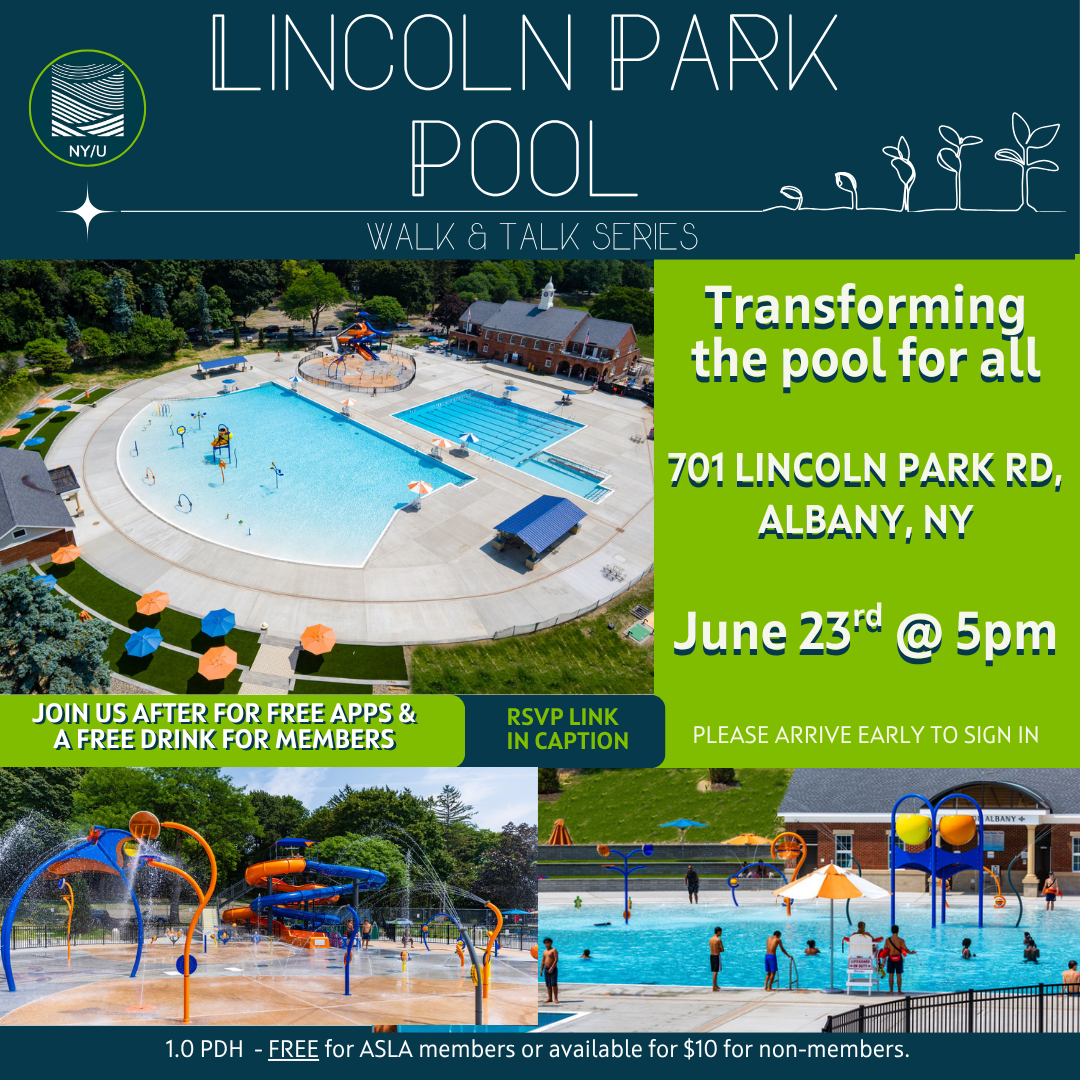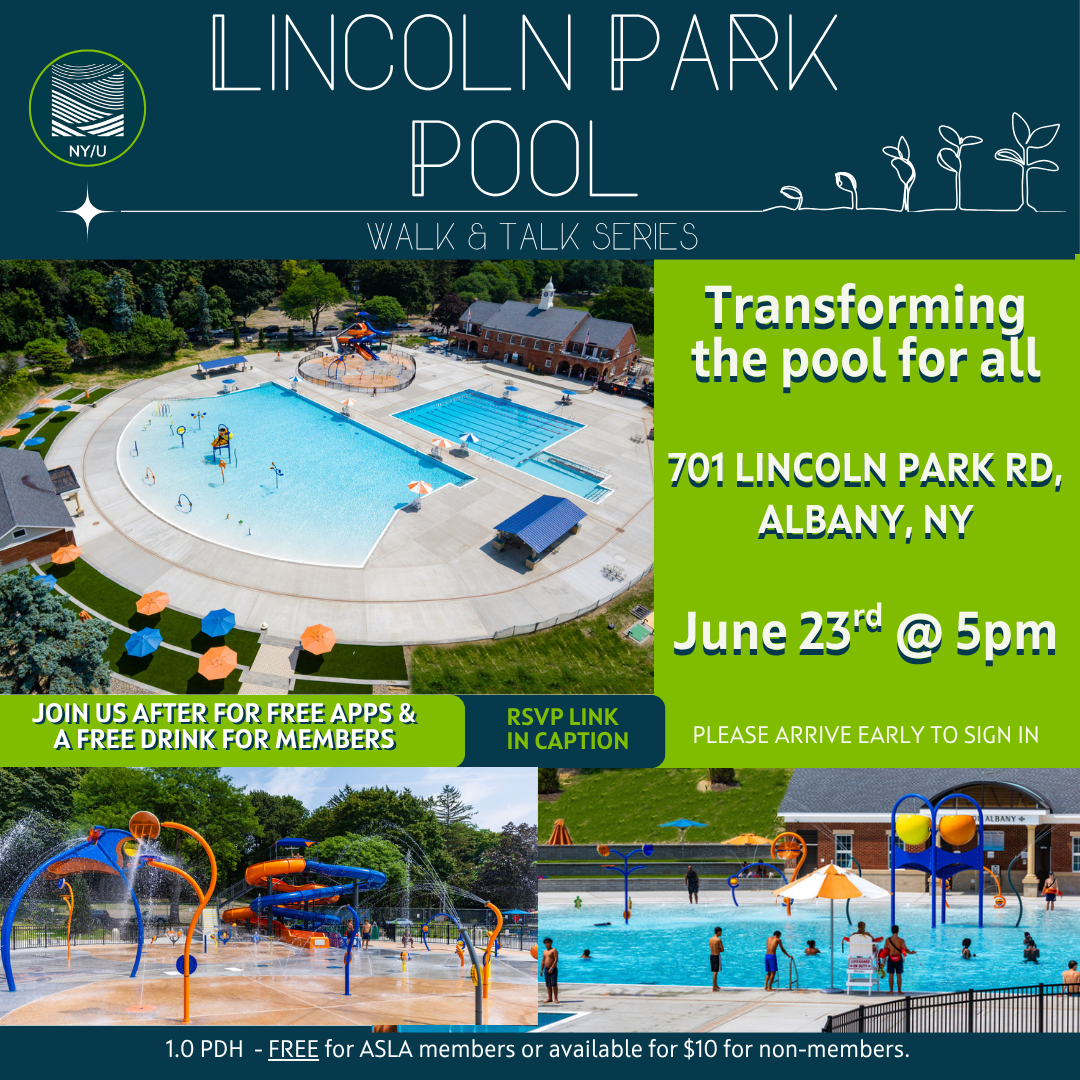
Jun
23
5:00 PM17:00

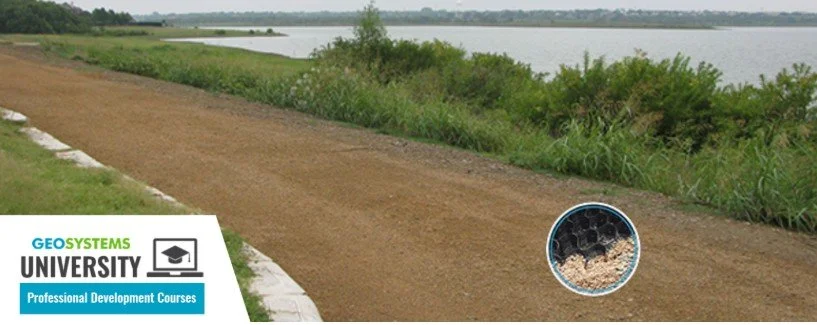
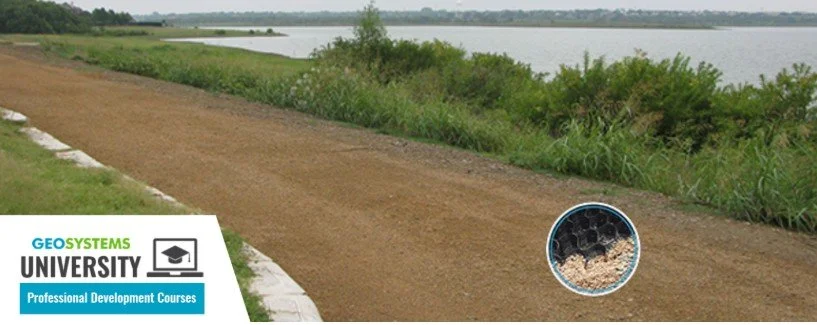
Trails and greenways play a vital role in communities by preserving and creating open spaces for low- or no-cost outdoor recreation. Trails designed with permeable surfaces rather than traditional concrete or asphalt allow for better environmental and stormwater management. Since recreational trails can be designed for a wide range of uses, including motorized and non-motorized traffic, it’s important to utilize a solution that is durable and flexible. In this webinar, we will explore a variety of soil stabilization and porous pavement products that can be tailored to the needs of individual projects—including those with hard-to-access areas and stormwater concerns. Multiple types of infill and anchoring methods allow for project customization, resulting in low-maintenance and attractive trails for years to come.
Trail embankment stabilization is another consideration when designing recreational trails. The embankments may be part of the existing natural terrain or result from cuts made to accommodate the construction of the new trails. Depending on embankment steepness, the GEOWEB® System can be used to stabilize slopes with single-layer protection or near-vertical, tiered retaining walls with a vegetated fascia. GEOWEB green slopes and living walls protect against erosion, reduce stormwater runoff, and create a natural environment for sustainable vegetation.
Learning Objectives:
Understand the fundamentals of successful trail design and construction to reduce degradation caused by traffic and natural elements.
Learn how different trail uses can affect the design and installation of a trail.
Learn how trails can be built through wetlands and protected areas with minimal environmental impact.
Know what types of products are appropriate for projects with unique conditions.
Learn how to ensure embankments along trails remain stable.
Learn how the GEOWEB System can protect against erosive forces and reduce stormwater runoff.
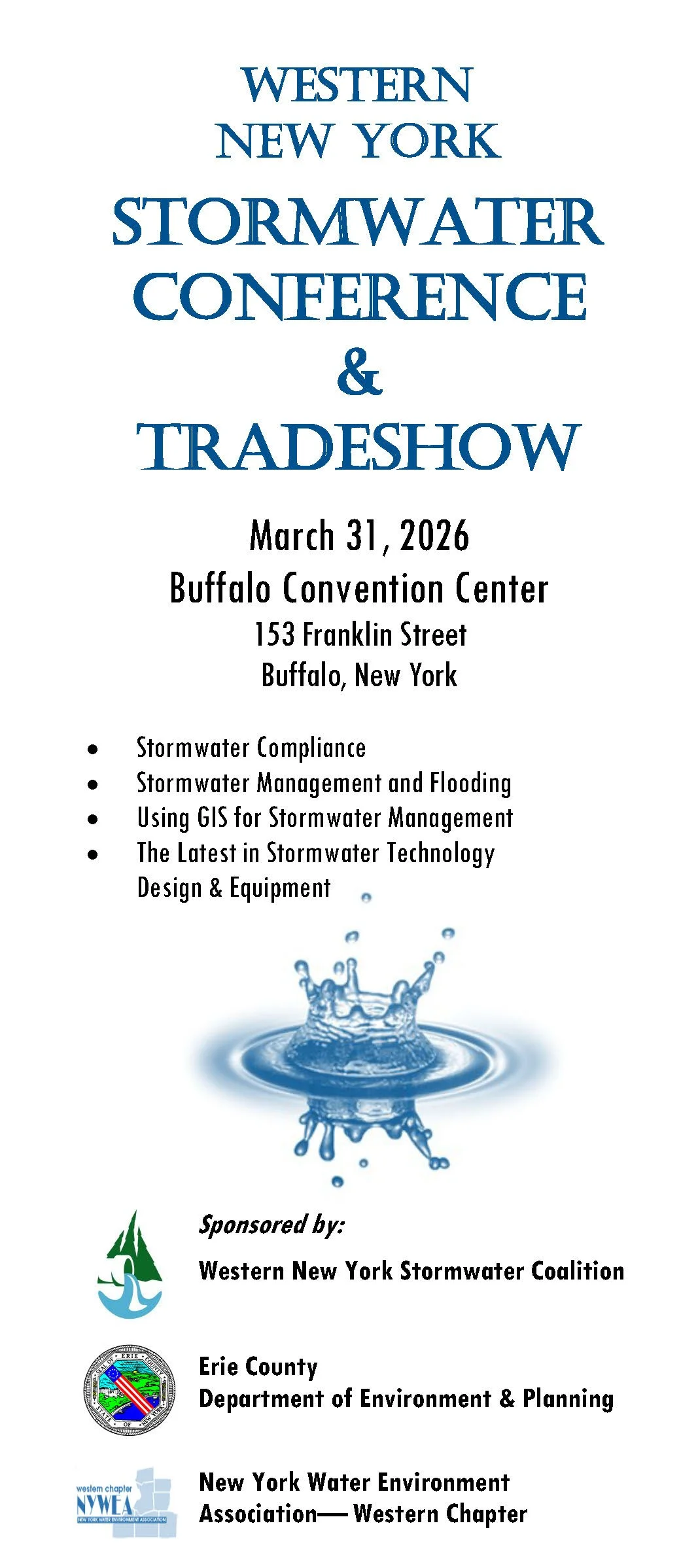
Join the Great Lakes Stormwater Collaborative in partnership with GLISA and RAND for a webinar on Stormwater Vulnerability Assessment development and implementation. The webinar will feature RAND's Practical Guide to Vulnerability Assessments for Stormwater Agencies and GLISA's Floodwise Communities Tool and Program, including a local perspective on implementing these tools in the City of Goshen, Indiana. Tune in to learn how communities and stormwater agencies can prioritize actions to adapt to identified stressors, foster resilience, and improve compliance and adaptation planning for stormwater infrastructure.
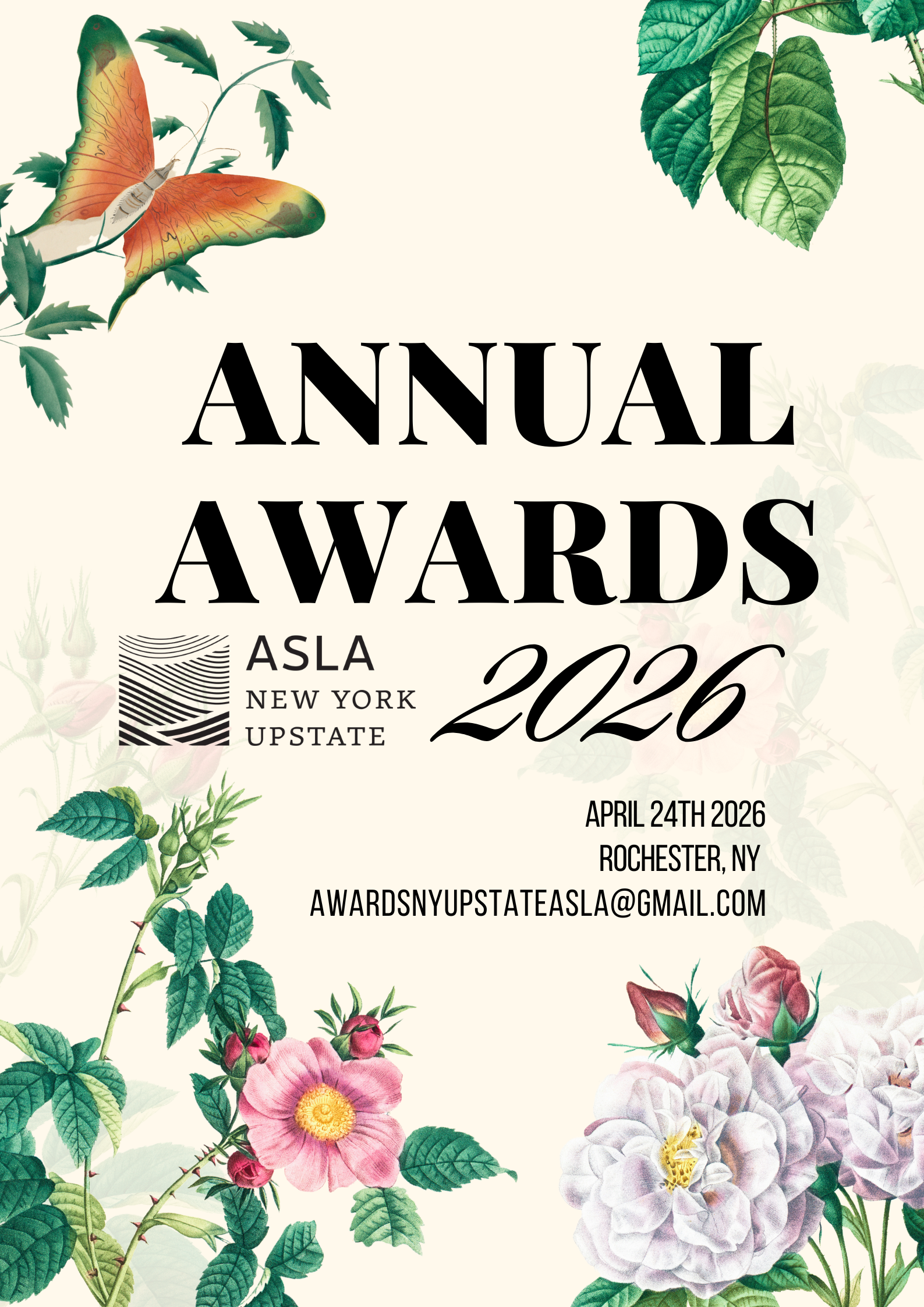
Awards Registration for the Dinner – April 24th @ 5PM
https://givebutter.com/2026-annual-awards-dinner-nfjixq
CEU Opportunity (1.5 Credits) – April 24th @ 2PM
https://givebutter.com/strong-museum-walking-tour-10-ceu-pngwnm
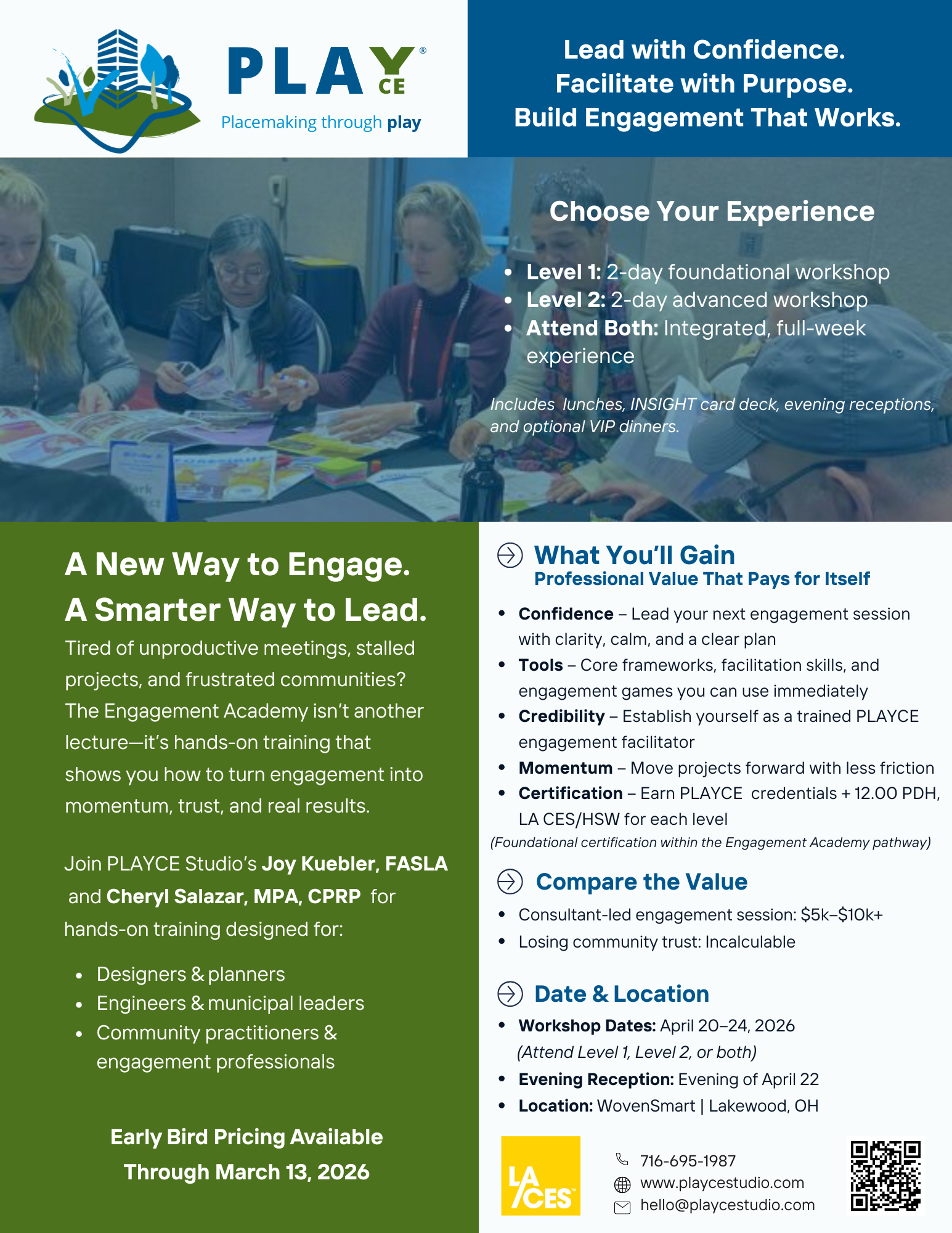
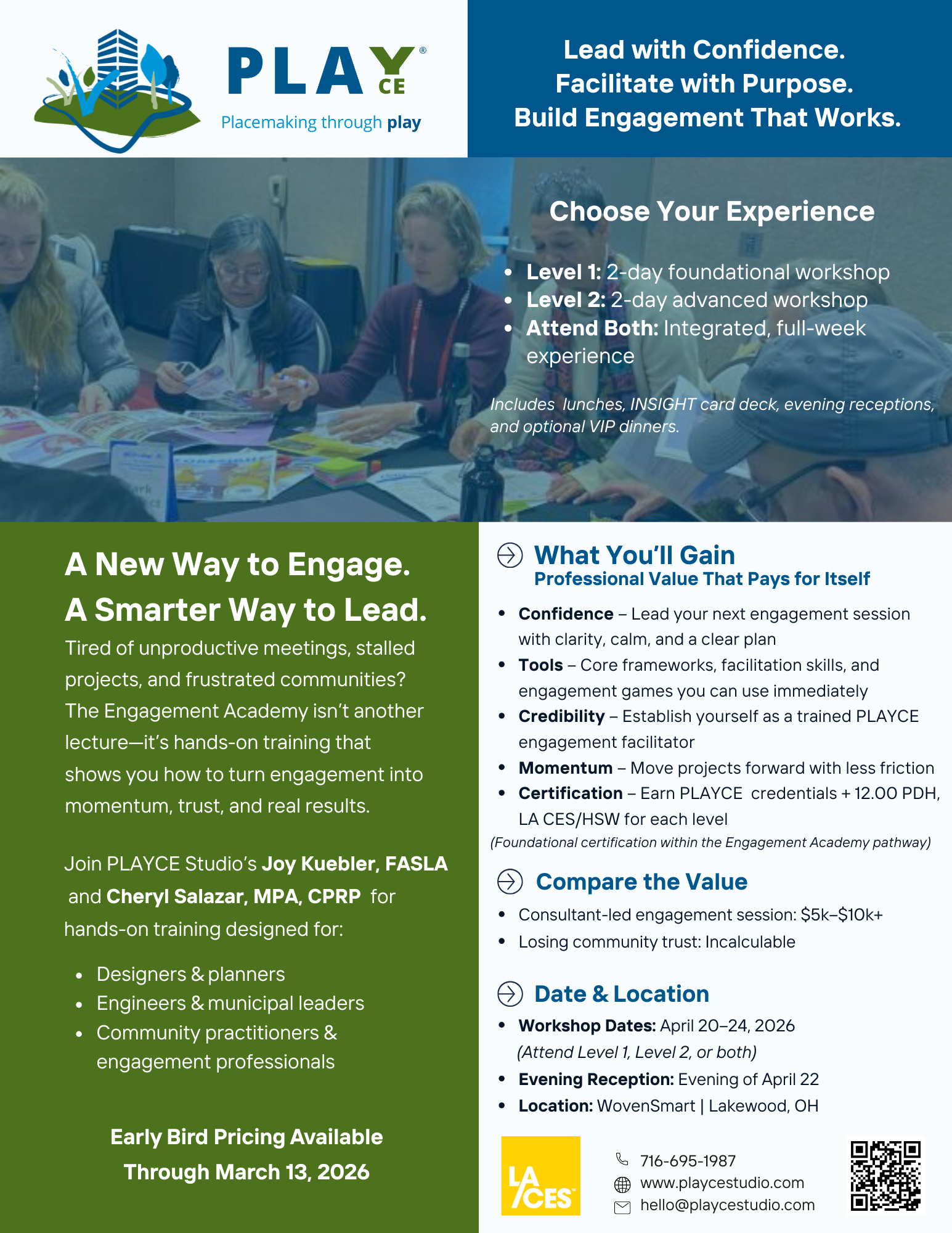
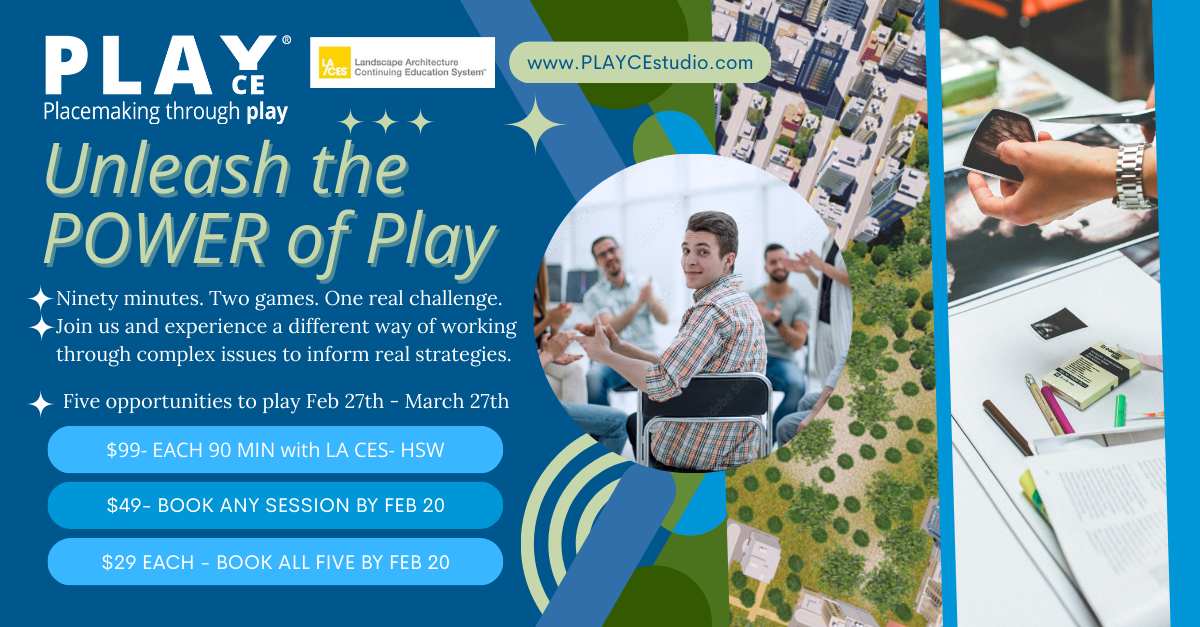
The Engagement Academy is for planners, designers, engineers, municipal leaders, and community practitioners who want to lead meaningful engagement themselves—with less friction, fewer iterations, and better outcomes. Each level is a standalone 2-day workshop grounded in PLAYCE’s playful placemaking methodology. Level 2 goes deeper, supporting participants in leading more complex conversations, navigating tension, and strengthening confidence in high-stakes settings and earns 12 LA CES +HSW Credits. Through hands-on practice and real-world application, participants leave equipped to design and facilitate engagement that works, without relying on outside consultants, and supported by a community of peers doing this work every day.
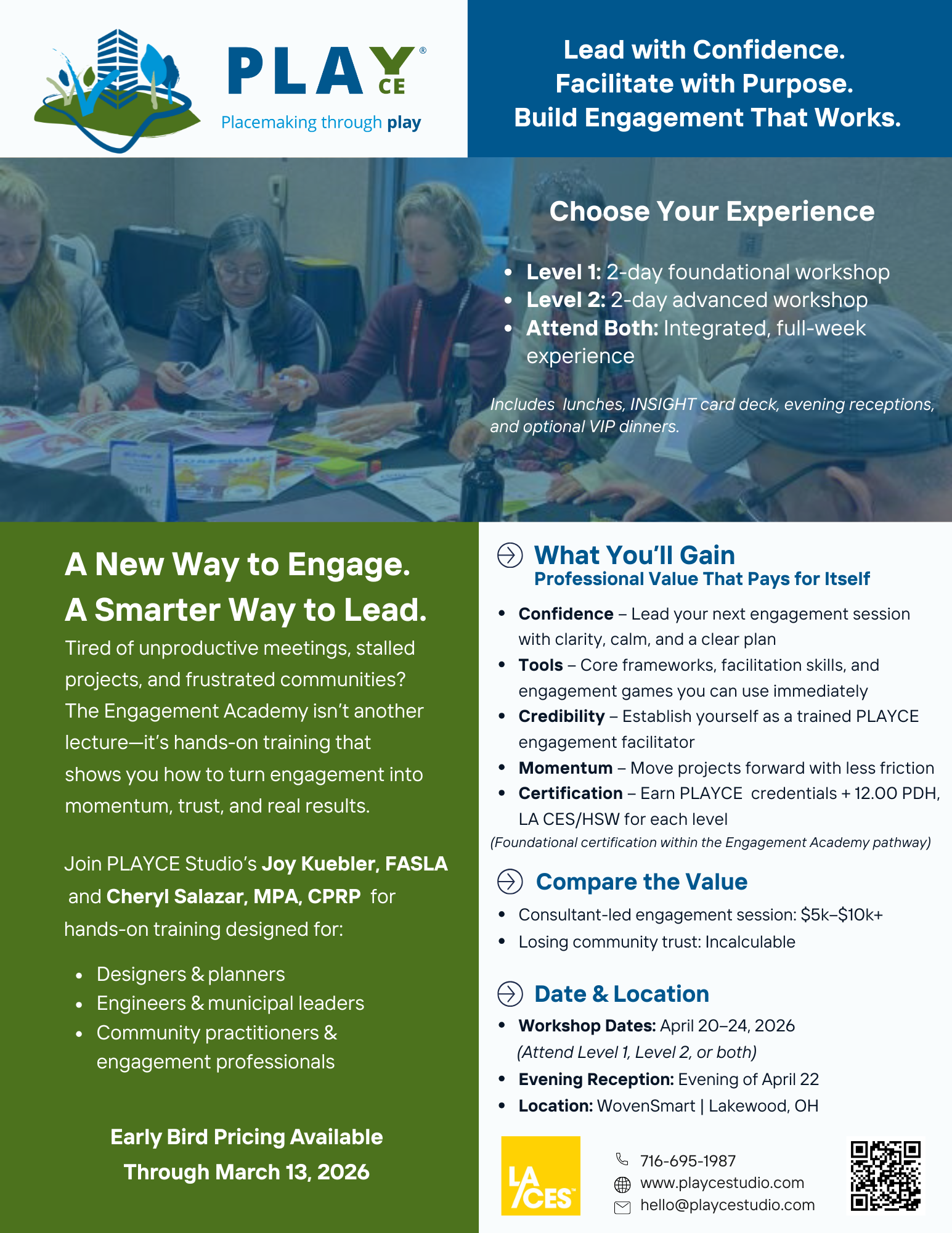
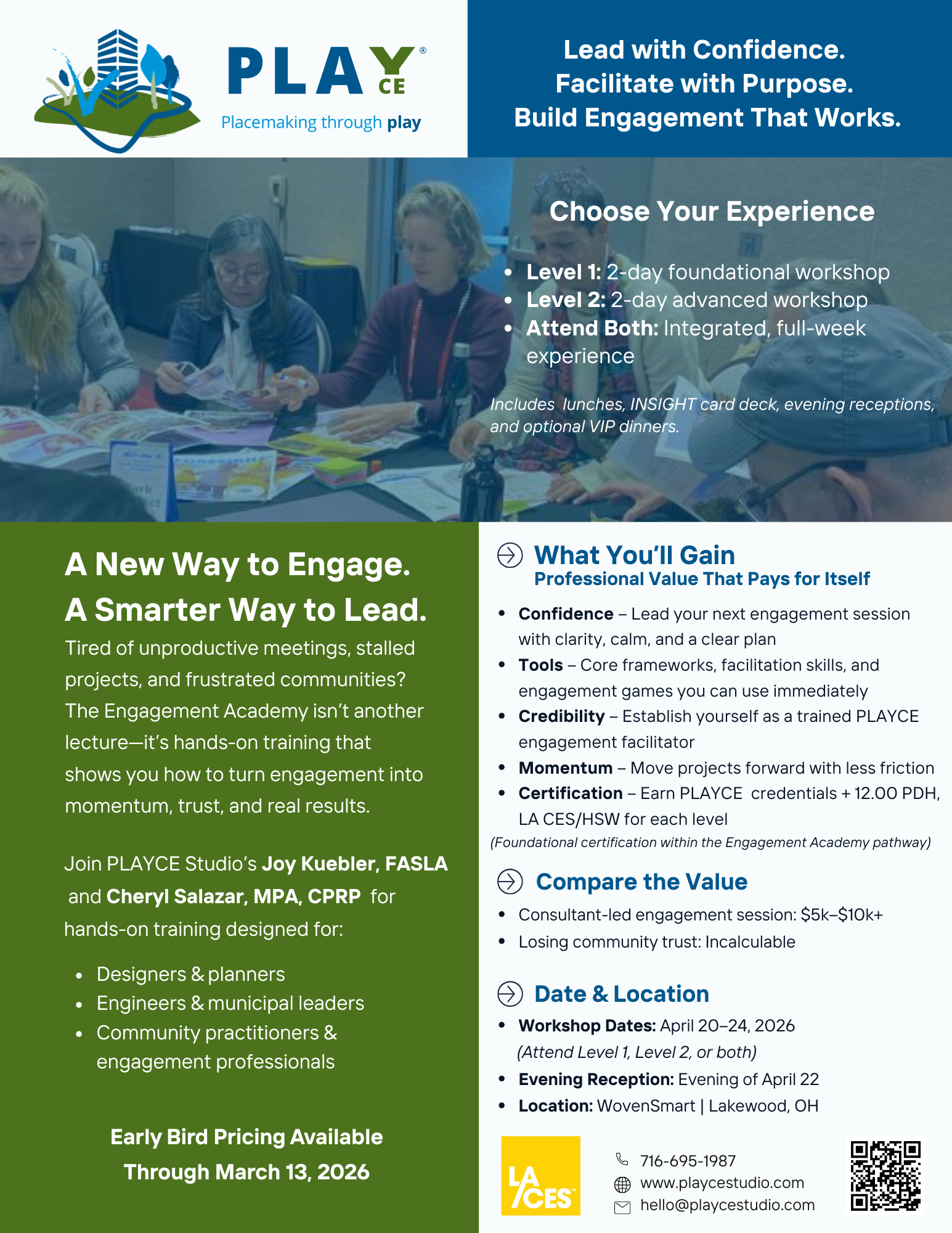
The Engagement Academy is for planners, designers, engineers, municipal leaders, and community practitioners who want to lead meaningful engagement themselves—with less friction, fewer iterations, and better outcomes. Each level is a standalone 2-day workshop grounded in PLAYCE’s playful placemaking methodology. Level 1 builds the foundations: purpose-driven facilitation, trust-building, and practical tools for gathering real community insight and earns 12 LA CES +HSW credits. Through hands-on practice and real-world application, participants leave equipped to design and facilitate engagement that works, without relying on outside consultants, and supported by a community of peers doing this work every day.
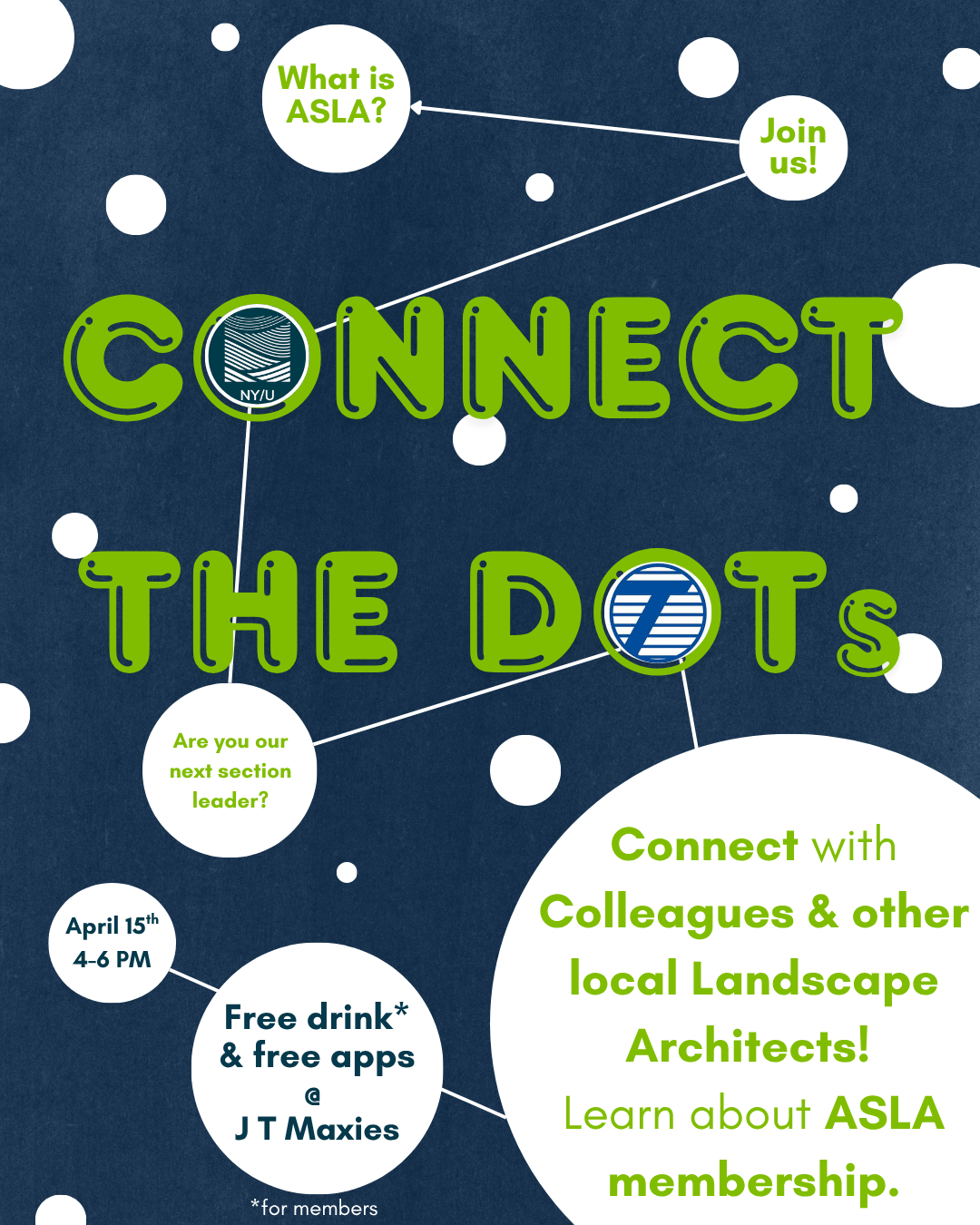
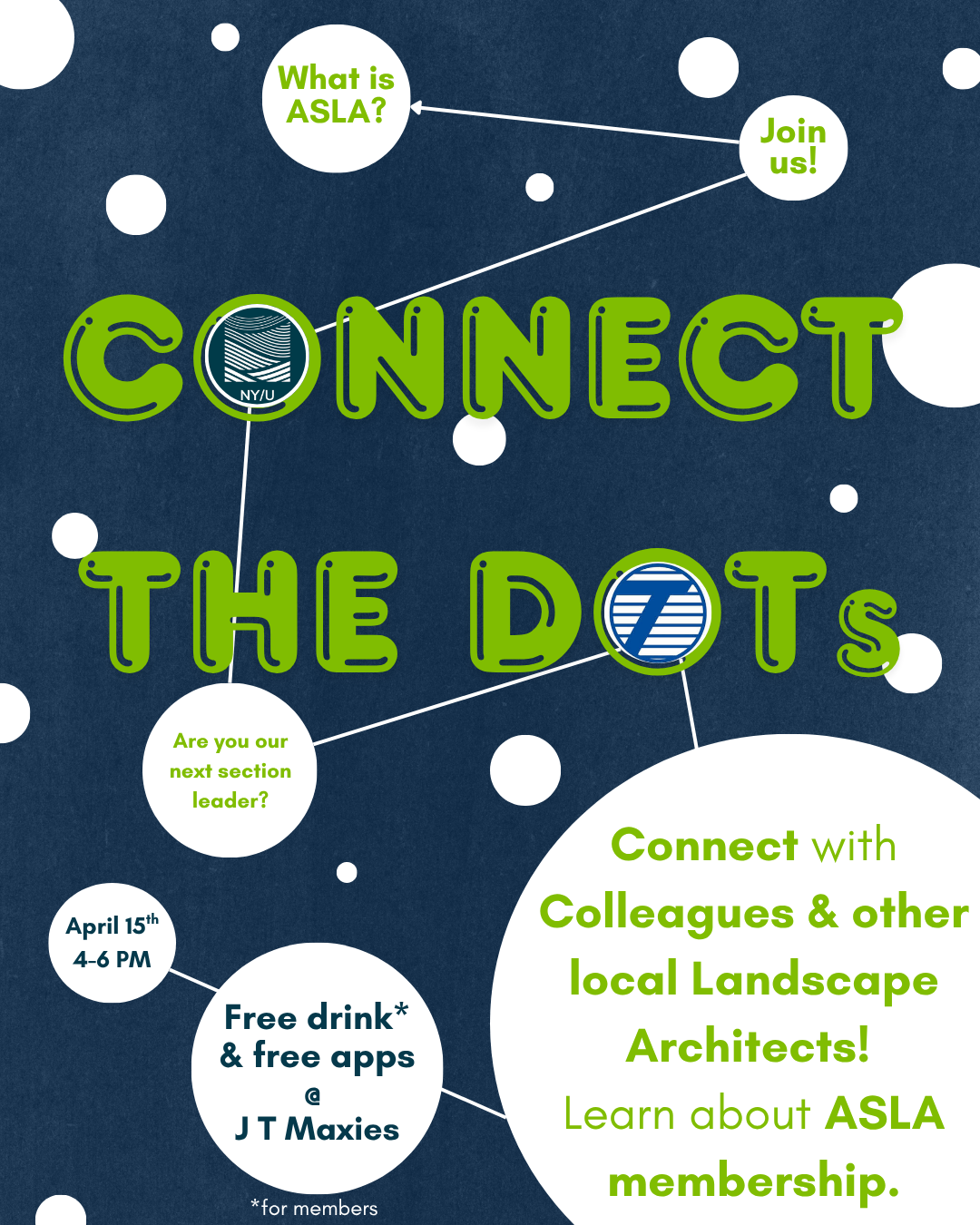
Come on down to J T Maxies on Wolf Road on Wednesday 4/15 from 4 pm - 6pm for a NYS DOT & NYU ASLA Happy Hour. There will be free apps and snacks for all and ASLA members get a free drink! This happy hour is meant to get the private and public sector mingling and to educate about membership benefits. And also looking for a new section leader.
Reach out to Diane or Sara with any questions!
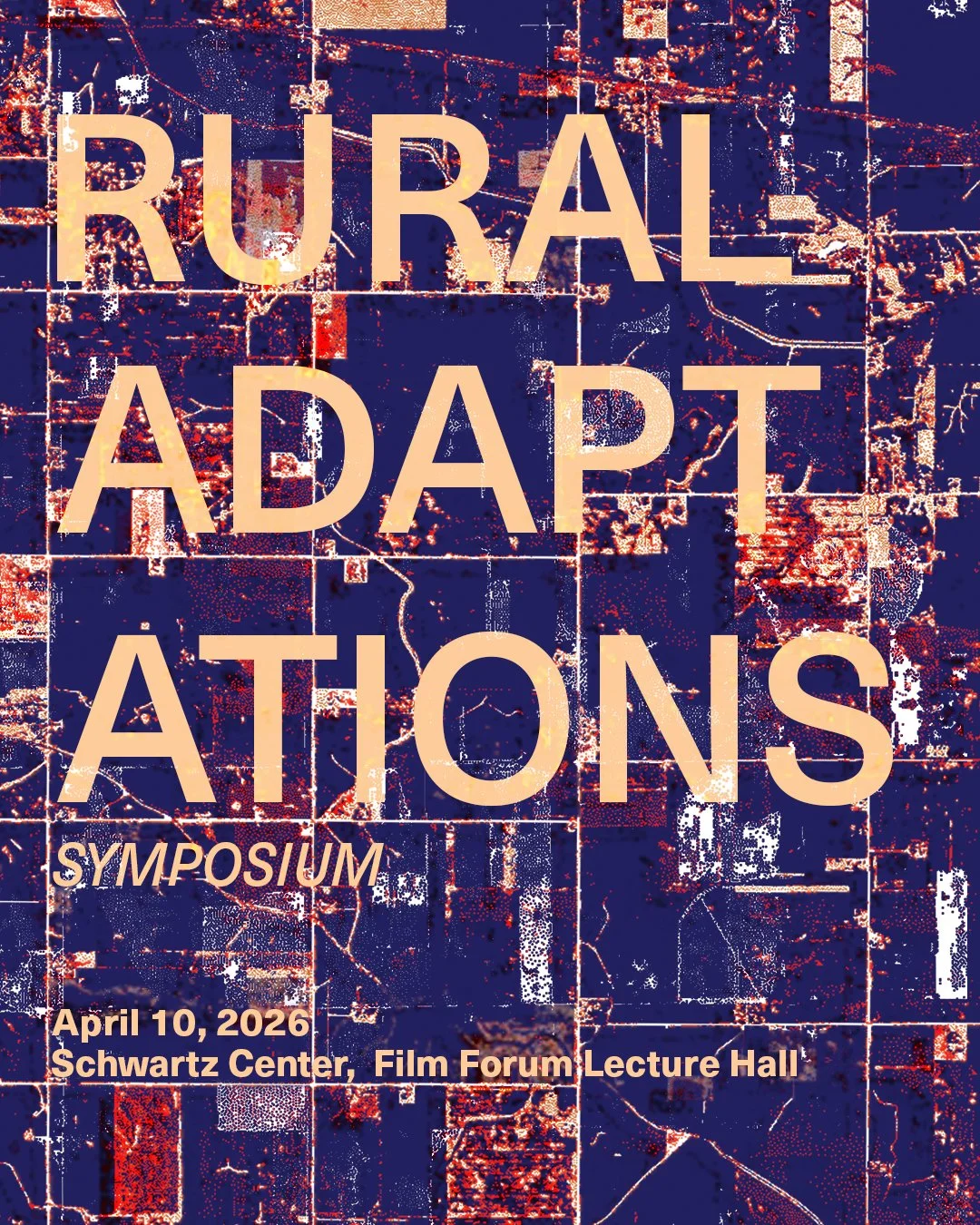
Rural landscapes—from farmlands to forests—are already confronting intensifying pressures driven by climate change. Rising temperatures, severe drought, flash flooding, and increasingly severe wildfires are reshaping ecological systems and rural livelihoods. New energy landscapes, from solar ’farms’ to rare earth mining, disproportionately impact rural communities, creating increased land use conflicts, habitat fragmentation, and environmental impacts. However, rural lands also offer great opportunities to mitigate impacts, from regenerative practices in farming, to afforestation of marginal and mine lands, to the sequestration of carbon in soils and subsurface geology. Together, these converging pressures and opportunities are driving rapid transformations of rural environments and require pro-active discussions about the role of design to help improve the ecological, social, and economic resilience for rural lands. Design is the space where land-based sciences converge to create grounded, real-world interventions. Connecting fragmented habitats, the siting of new energy infrastructures, and the development of nature-based infrastructures are spatial questions requiring design responses that build from multiple disciplines to create solutions that build real-world impact. Sensitive rural design, built from trans-disciplinary knowledge, offers the potential to build more resilient rural futures through emerging research, pilot projects, and radical collaborations.
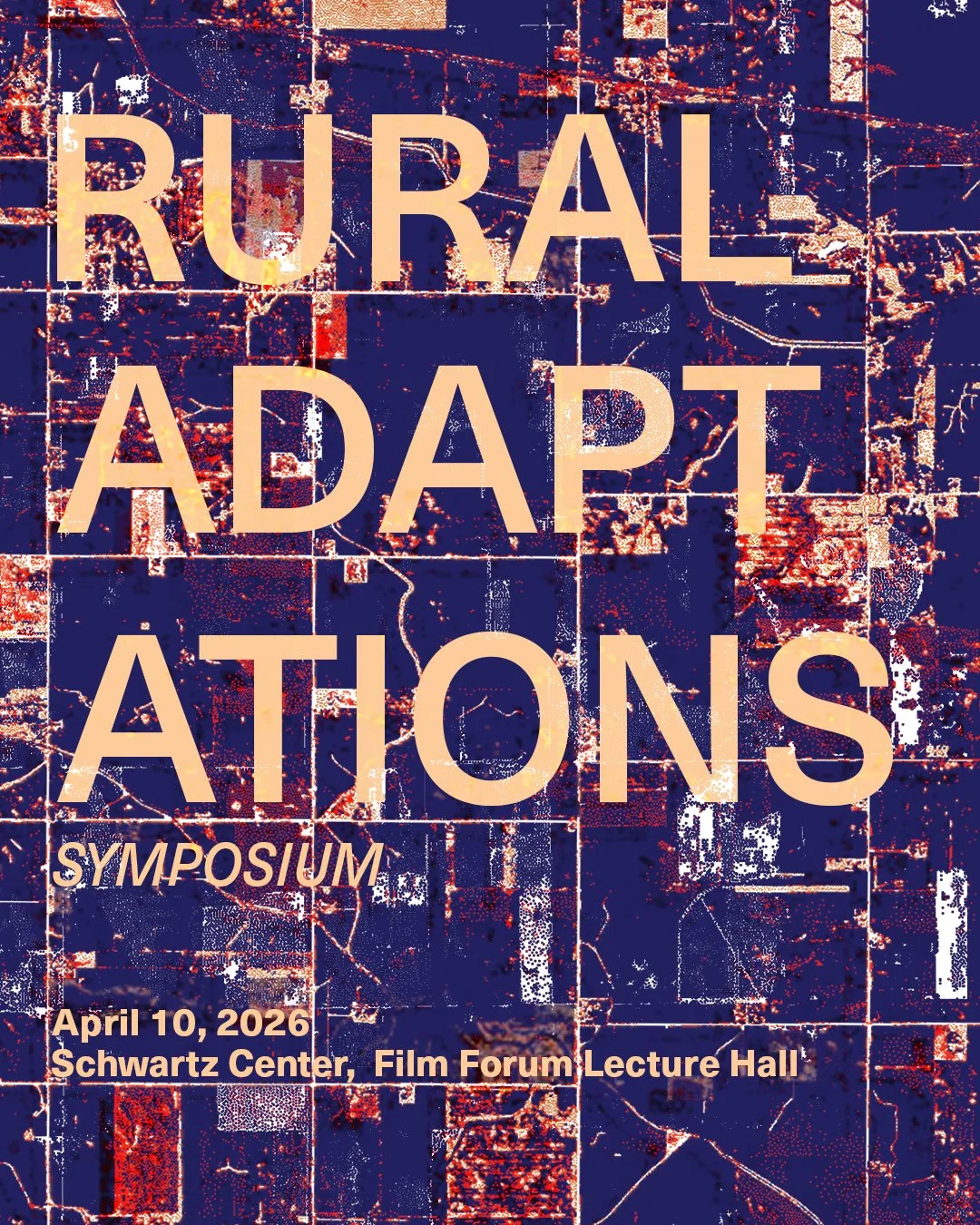
The Rural Adaptations symposium will connect global experts with regional practitioners and researchers in the sphere of rural design to discuss some of the most urgent challenges to rural communities and highlight innovative projects that support more resilient futures. As the first in a series hosted by Cornell’s Department of Landscape Architecture, the symposium launches a broader initiative to foster cross-sector collaboration around climate-responsive design. Organized around four thematic tracks—Field, Forest, Energy + Extraction, and Lowlands—the program highlights professional practice, academic research, nonprofit initiatives, and Indigenous-led projects. The Rural Adaptations symposium aims not only to bridge research and practice, but also to build enduring connections across disciplines and organizations—laying the groundwork for the radical collaborations necessary to shape more resilient rural futures.
LA-CES Credits available through ASLA-Upstate NY. For complete event details, please contact the department (lafield@cornell.edu) for more information.
Rural Adaptations is organized by Assistant Professor Anne Weber at Cornell University. This program is made possible through Cornell University’s Department of Landscape Architecture.

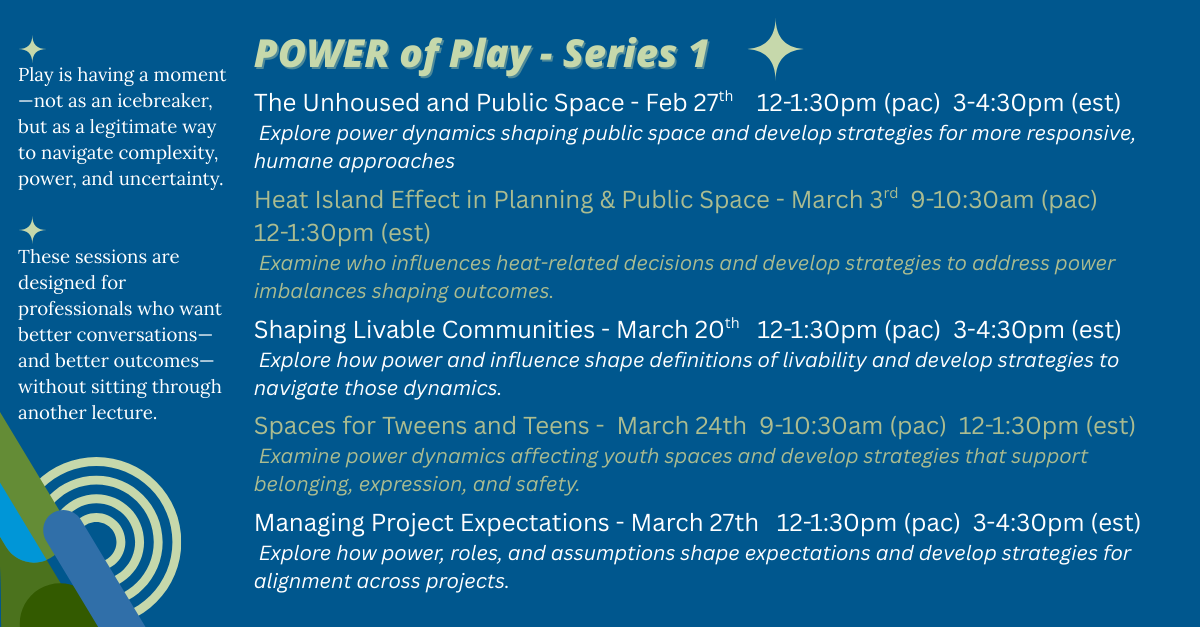
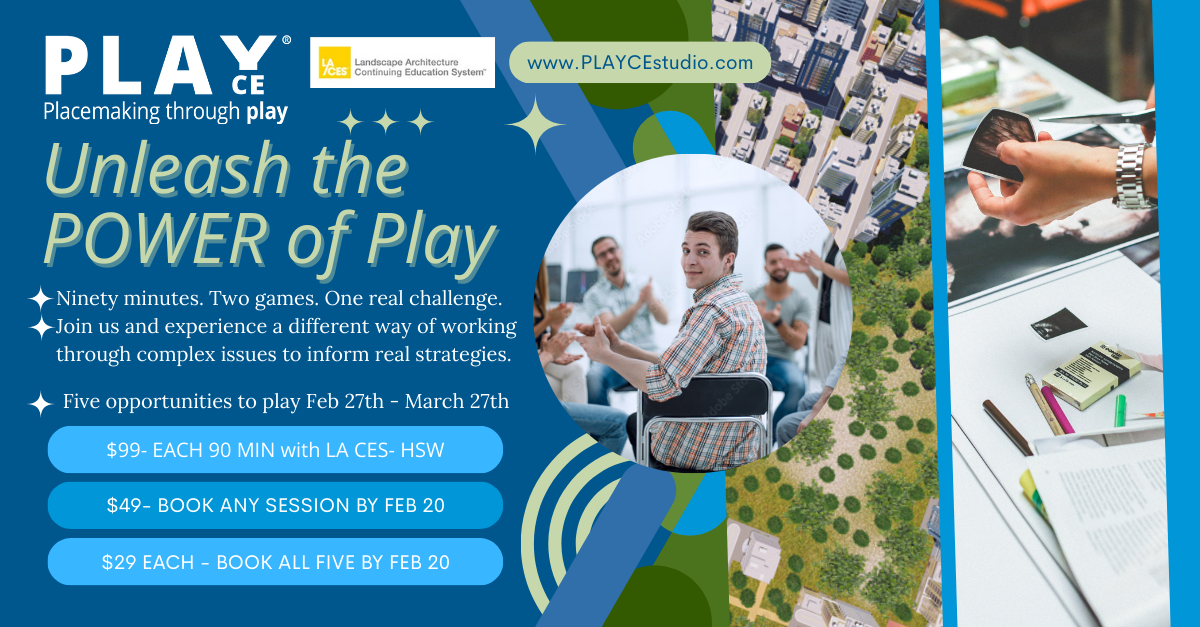
Managing project expectations is a shared challenge across design, planning, and municipal work, whether participants act as clients, practitioners, or partners. This ninety-minute interactive session explores how expectations are formed, communicated, and reinforced over time. Through facilitated group exercises and structured dialogue, participants examine power dynamics related to roles, authority, and assumptions, and collaboratively explore strategies for setting, revisiting, and recalibrating expectations to support more effective project delivery.


Recreation and play spaces for tweens and teens are often shaped by planning decisions, safety concerns, and public expectations. This ninety-minute interactive session explores how these factors influence youth-focused spaces in parks and public environments. Through facilitated group exercises and structured dialogue, participants examine power dynamics related to age, risk, expression, and municipal responsibility, and collaboratively explore strategies that can inform more supportive, inclusive recreation and public-space decisions for youth.

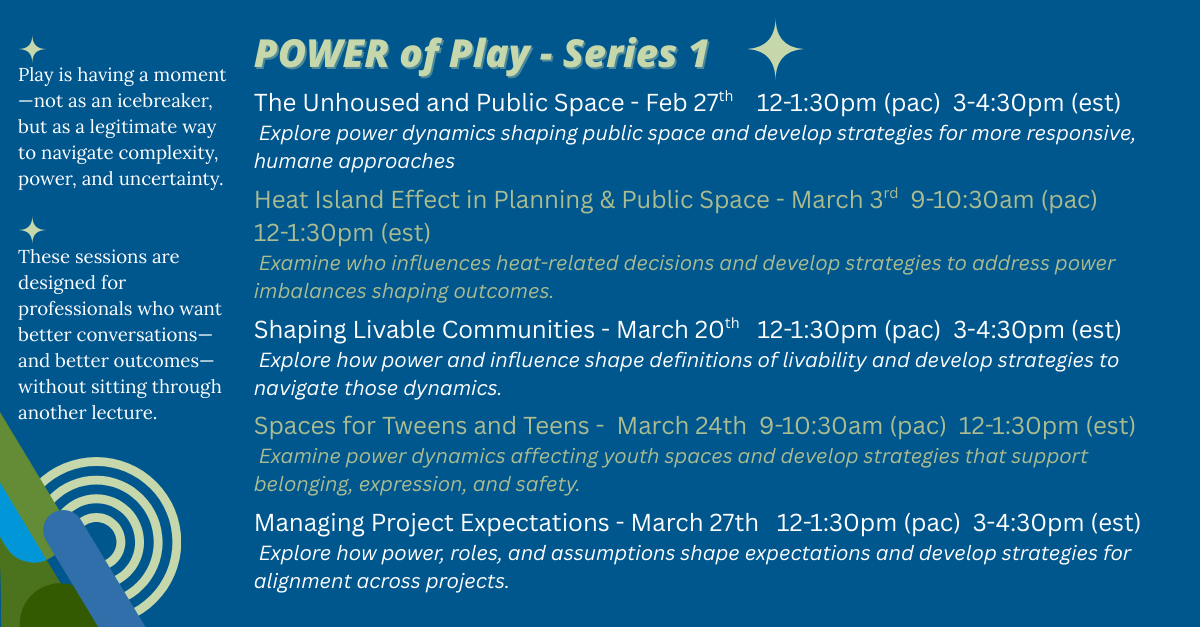
Livable communities are often described as places that support choice, health, equity, and quality of life, yet these definitions are shaped by power, assumptions, and decision-making structures. In this ninety-minute interactive session, participants explore how livability influences land use, housing, transportation, and public space outcomes. Through facilitated group exercises and structured dialogue, participants examine power dynamics and collaboratively explore strategies to address whose values and experiences are centered in planning and design decisions.

Mark Your Calendars. Lounge & Learn is back!
Earn CEUs from the comfort of your couch (or desk) and spend time virtually with your NYU ASLA friends. Presentations will be held on Wednesdays in February (2/18 & 2/25) and March (3/4 & 3/11) at 4 pm over Zoom. Additional information on topics and registration will be available soon.
Registration opens February 9th. Register here: https://givebutter.com/LoungeLearn2026
Big thank you to our sponsors - and we’re always looking for more! Please reach out to Terry at terry@riversorg.com to learn more and secure your sponsorship spot today!
Mark Your Calendars. Lounge & Learn is back!
Earn CEUs from the comfort of your couch (or desk) and spend time virtually with your NYU ASLA friends. Presentations will be held on Wednesdays in February (2/18 & 2/25) and March (3/4 & 3/11) at 4 pm over Zoom. Additional information on topics and registration will be available soon.
Registration opens February 9th. Register here: https://givebutter.com/LoungeLearn2026
Big thank you to our sponsors - and we’re always looking for more! Please reach out to Terry at terry@riversorg.com to learn more and secure your sponsorship spot today!

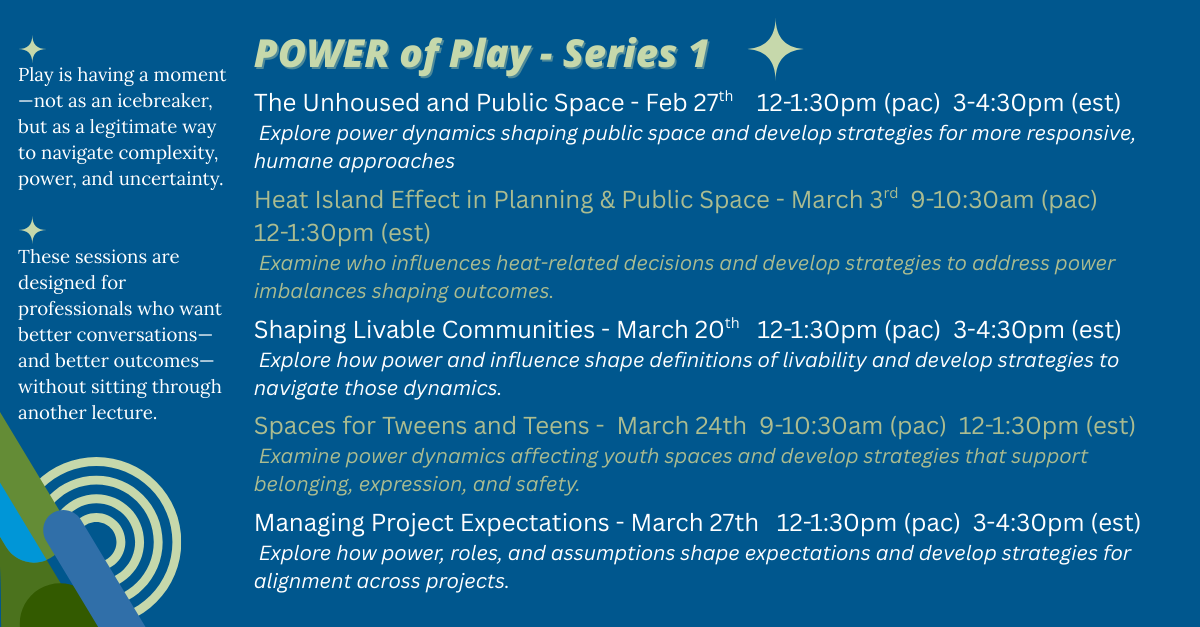
This ninety-minute interactive session focuses on heat island effects as they relate to planning, landscape architecture, and municipal contexts. Participants explore how land use patterns, municipal design standards, and the interpretation of health research shape heat conditions across communities. Through facilitated group exercises and structured dialogue, participants examine power dynamics influencing decision-making and collaboratively explore strategies that can inform future planning, design, and public-space decisions related to heat island impacts.
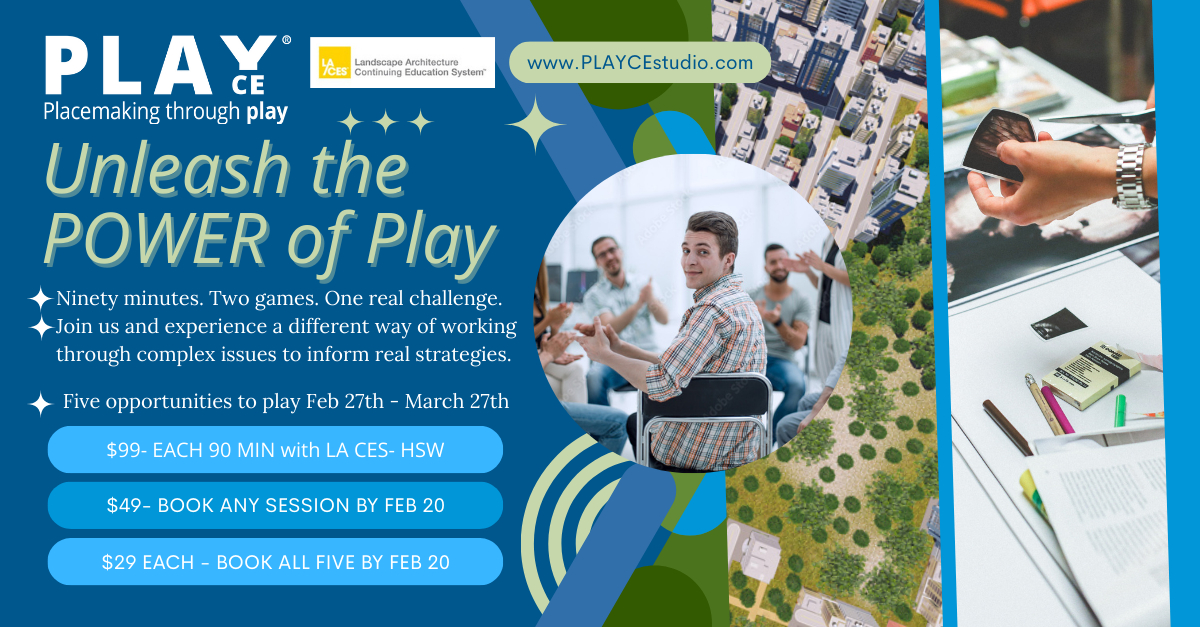

This ninety-minute interactive session focuses on homelessness in the public realm as it appears in planning, landscape architecture, and municipal contexts. Participants explore how public space decisions intersect with community health, safety, and welfare. Through facilitated group exercises and structured dialogue, participants examine power dynamics, surface diverse perspectives, and generate potential strategies relevant to their professional work.

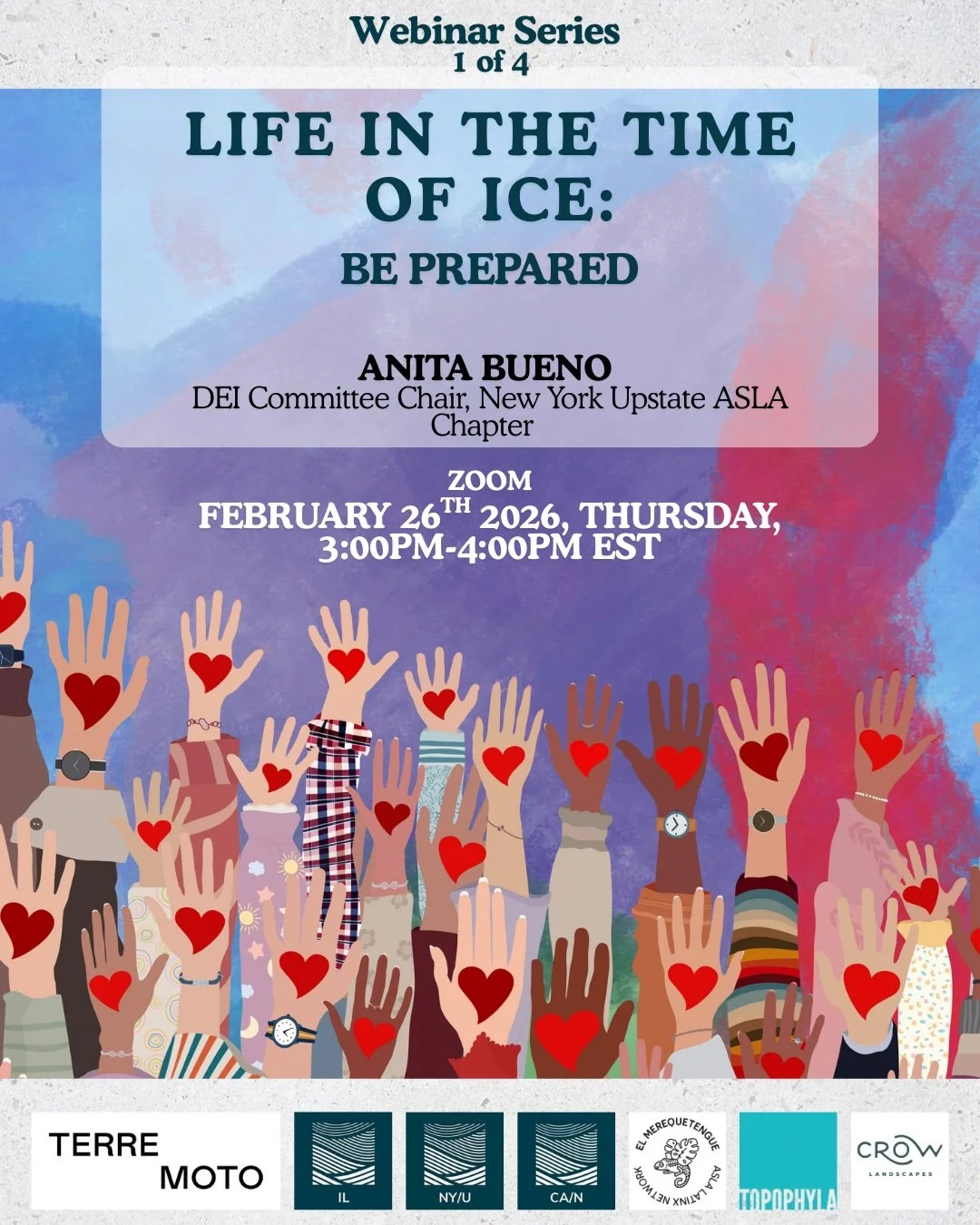
At a time when we see human rights being blatantly disregarded, community building becomes a political act. Immigrant America is a living and dignified part of our society whose rights must be advocated for and protected. This year we started a collaboration between El Merequetengue (network of Latin American landscape architects and designers), Illinois, New York Upstate, ASLA-NY, and Northern California ASLA chapters, TERREMOTO, TOPOPHYLA Landscape Architecture, Bethany Rydmark Landscapes, and CROW Landscapes, to learn about our constitutional and legal rights, build acknowledgment, share resources, and support each other in times of fear and uncertainty.
The collaboration quickly grew and flourished in the planning of a series of webinars called Life in the Time of ICE. We poured our frustration, insecurity, and desire to be proactive into action by forming a collective work of affiliate groups, ASLA regional chapters, and landscape architecture firms all interested in learning how to navigate the unconstitutional attacks on the immigrant community.
The intention of the webinar series is to offer the landscape architecture community key information, resources and opportunities to stay safe while taking action. The series includes four parts:
Be Prepared: a general overview of what’s happening, your legal rights, trends, tactics, how to create a workplace or individual plan.
Be an Advocate: ways to build acknowledgment and share experiences and resources.
Learn: a session to know your rights led by an ACLU attorney.
Take Action: how to put what we’ve learned into practice.
The first webinar, Be Prepared, will be hosted by New York Upstate ASLA Chapter on February 26th at 3 pm EST. You can register here.
Stay tuned for the registration links for the following webinars on our Instagram accounts! We invite you to join us, learn more about how to support the immigrant community and continue the conversation.
Organizers
El Merequetengue
DEI Committee, ASLA Illinois Chapter
JEDI Committee, ASLA Northern California Chapter
DEI Committee, ASLA Upstate New York
TERREMOTO
TOPOPHYLA
CROW Landscapes
Bethany Rydmark Landscapes
ASLA-NY
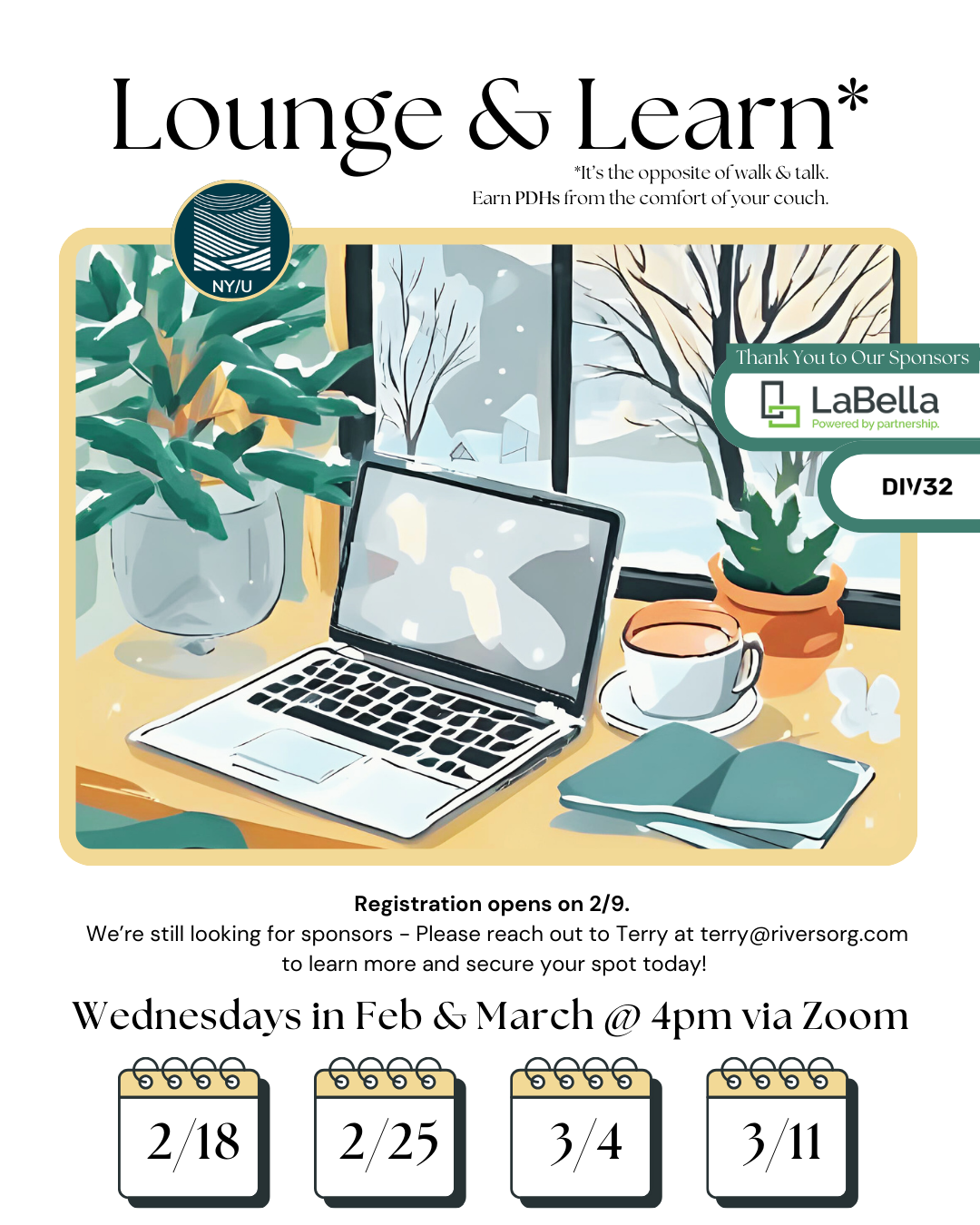
Mark Your Calendars. Lounge & Learn is back!
Earn CEUs from the comfort of your couch (or desk) and spend time virtually with your NYU ASLA friends. Presentations will be held on Wednesdays in February (2/18 & 2/25) and March (3/4 & 3/11) at 4 pm over Zoom. Additional information on topics and registration will be available soon.
Registration opens February 9th. Watch your emails and our website for more information soon.
Big thank you to our sponsors - and we’re always looking for more! Please reach out to Terry at terry@riversorg.com to learn more and secure your sponsorship spot today!

Mark Your Calendars. Lounge & Learn is back!
Earn CEUs from the comfort of your couch (or desk) and spend time virtually with your NYU ASLA friends. Presentations will be held on Wednesdays in February (2/18 & 2/25) and March (3/4 & 3/11) at 4 pm over Zoom. Additional information on topics and registration will be available soon.
Registration opens February 9th. Register here: https://givebutter.com/LoungeLearn2026
Big thank you to our sponsors - and we’re always looking for more! Please reach out to Terry at terry@riversorg.com to learn more and secure your sponsorship spot today!
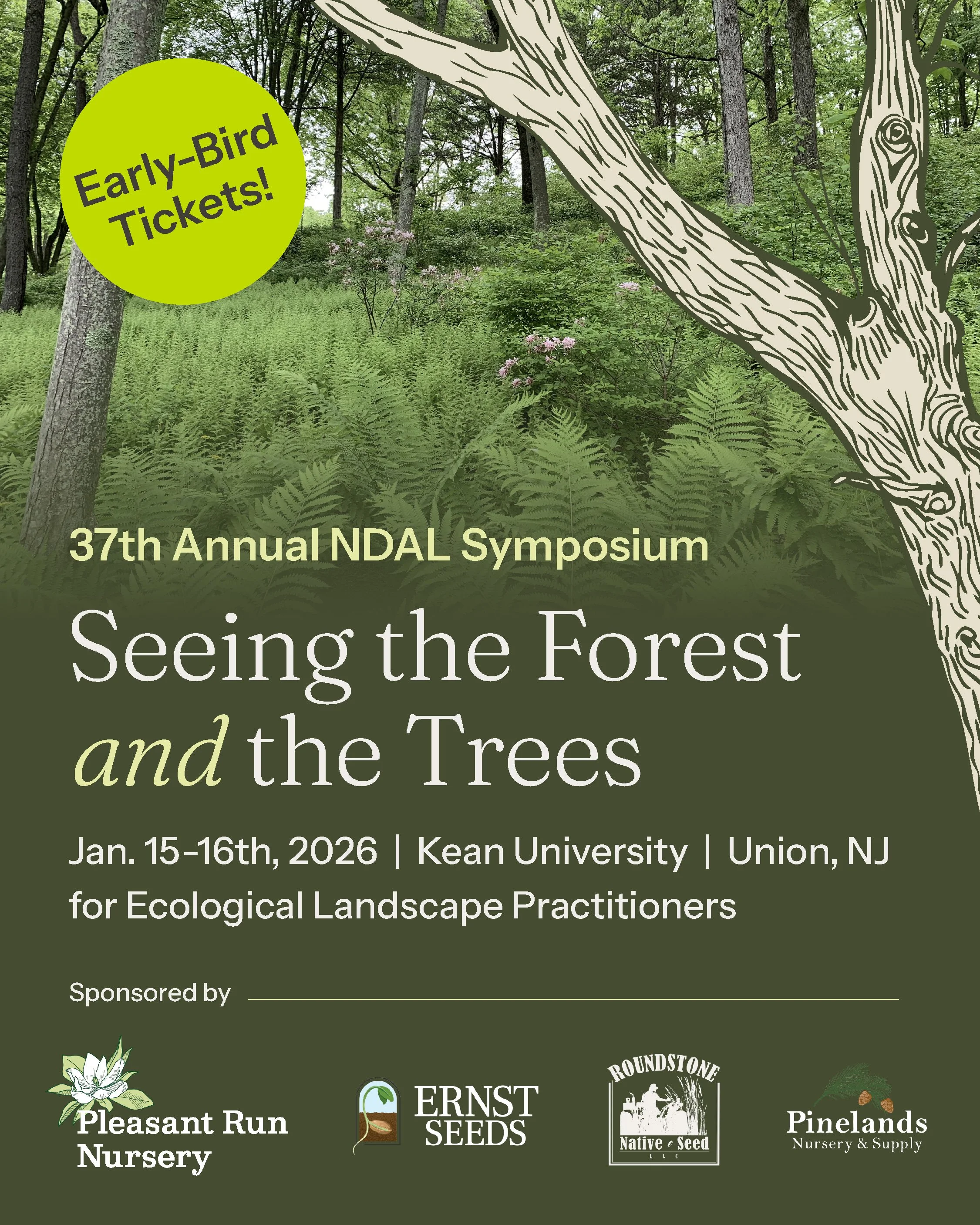
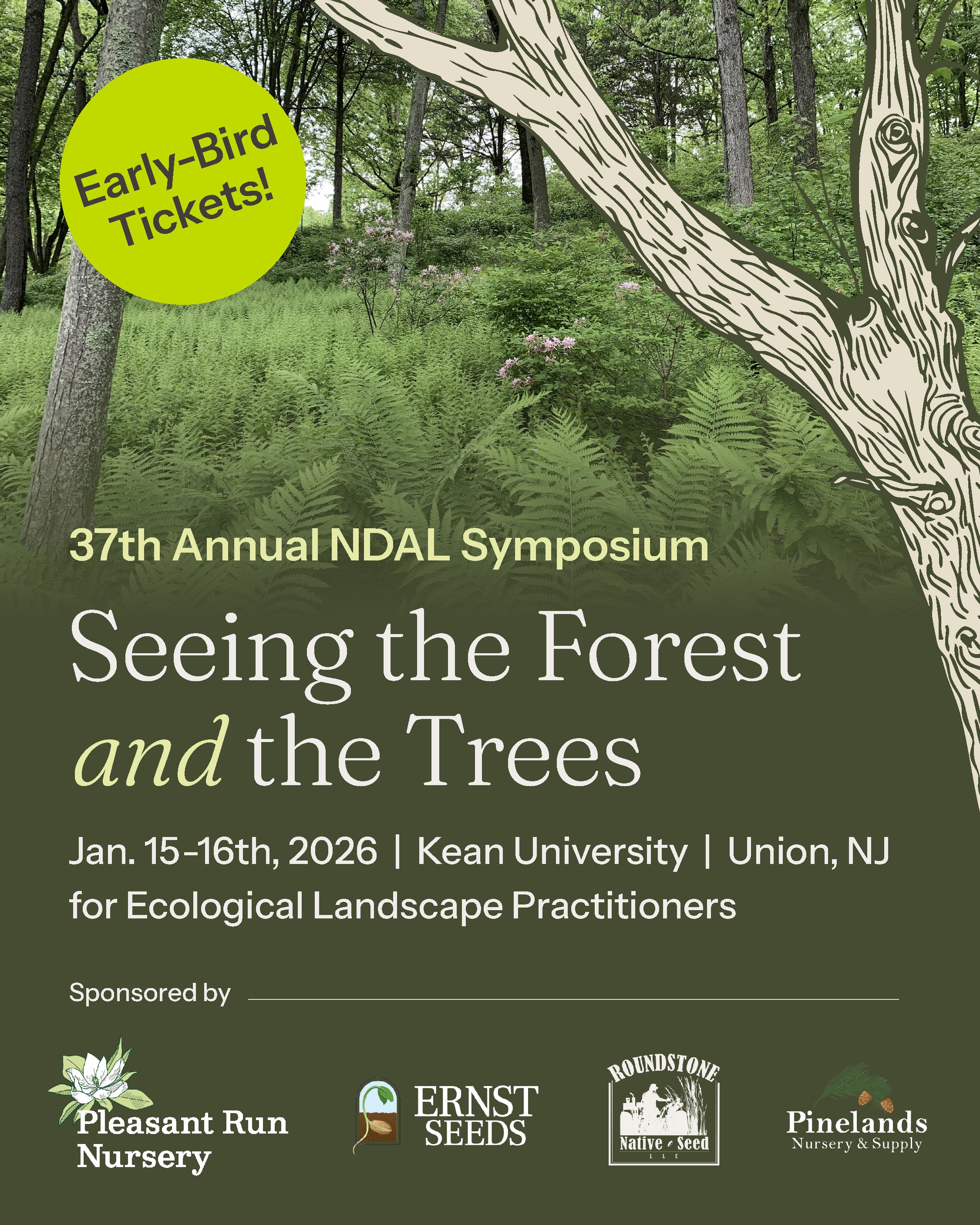
Incorporating a region’s indigenous plant communities and ecological processes is at the heart of ecology-based design. But no natural system operates in isolation or is forever immune to change…..especially today where the effects of watershed alteration, soil disturbance, plant globalization, and climate change are at play worldwide. Our Symposium will begin by zooming in on techniques for regionally-specific landscape analysis and design. We will then widen the lens and learn how disturbance, ecological science, and cultural land practices across regions can factor into those processes. Finally, we will explore how an expansive view of landscape art can unify this micro/macro divide in landscapes ranging from expansive to intimate.
Jan. 15-16, 2026 at Kean University in Union, NJ (just outside NYC)
CEUs & virtual options available
Register today! https://www.ndal.org/2026-annual-symposium
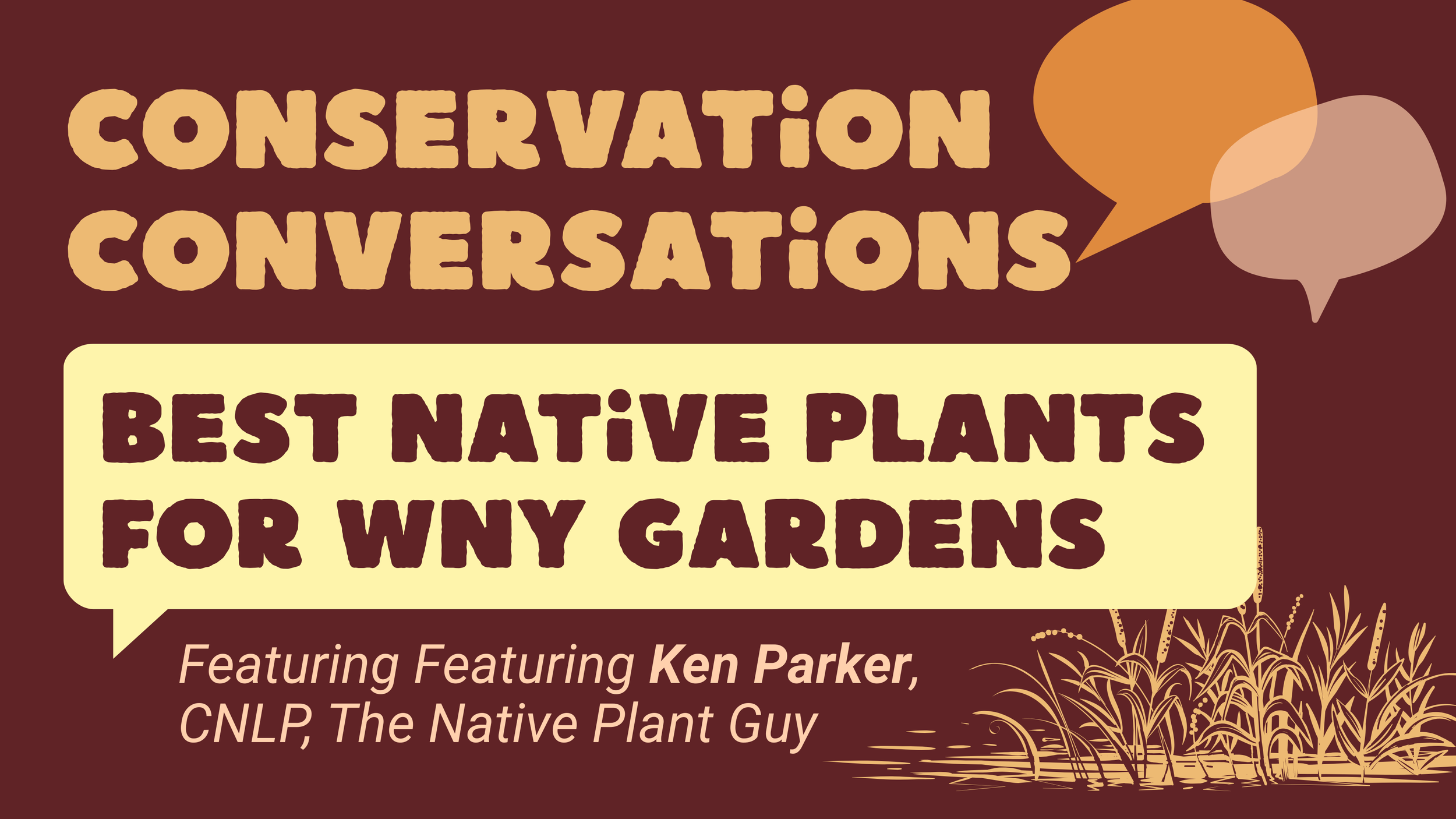
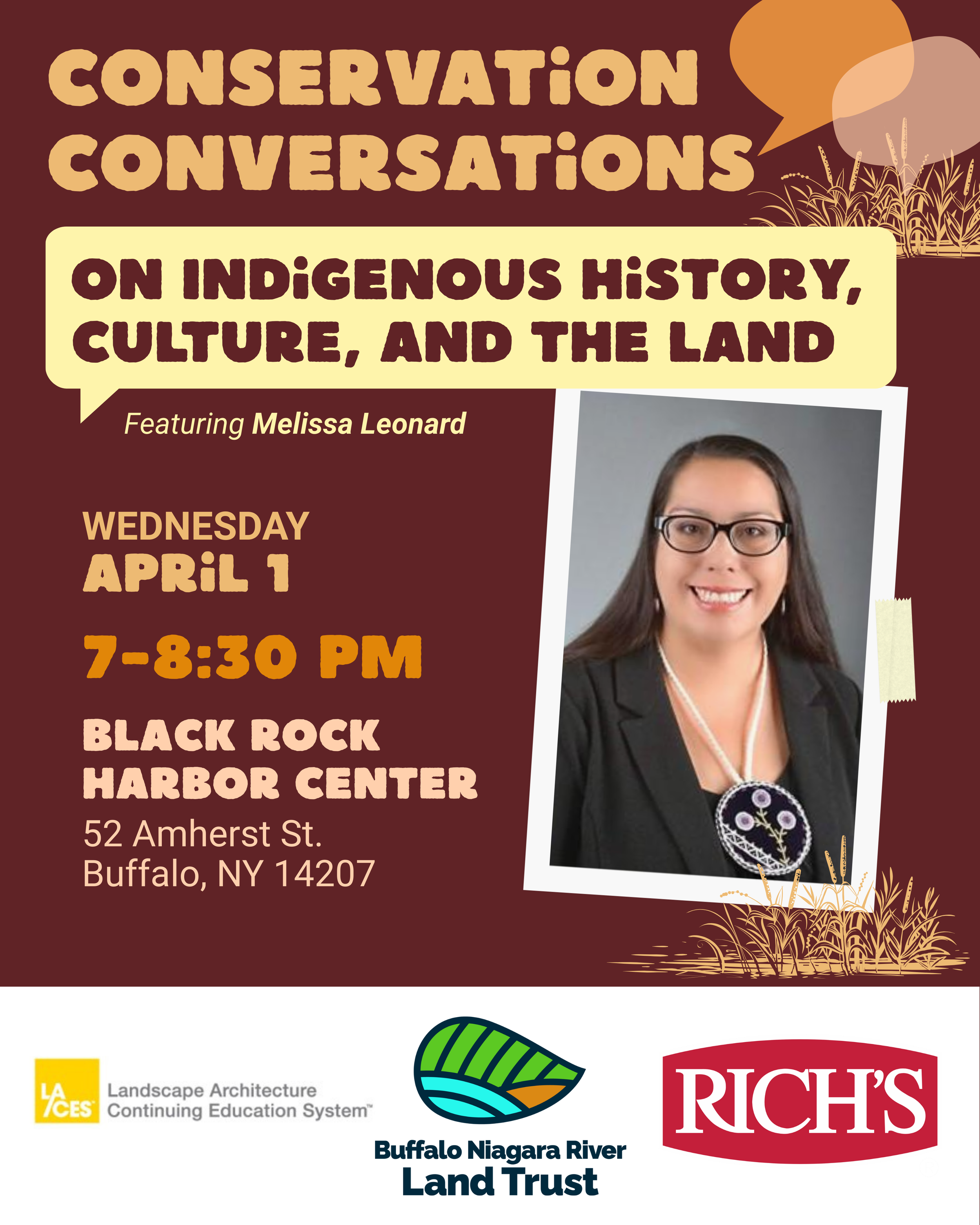
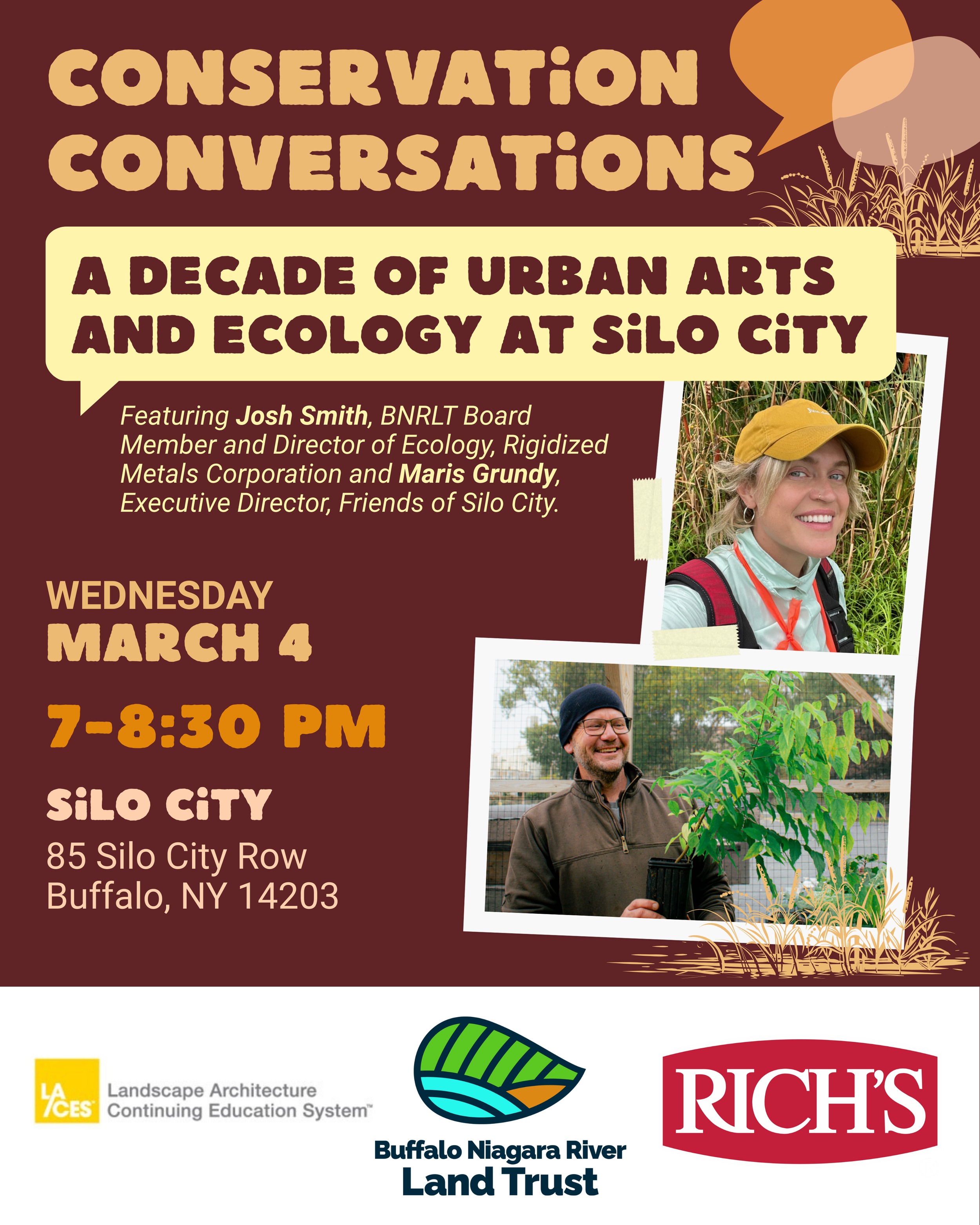
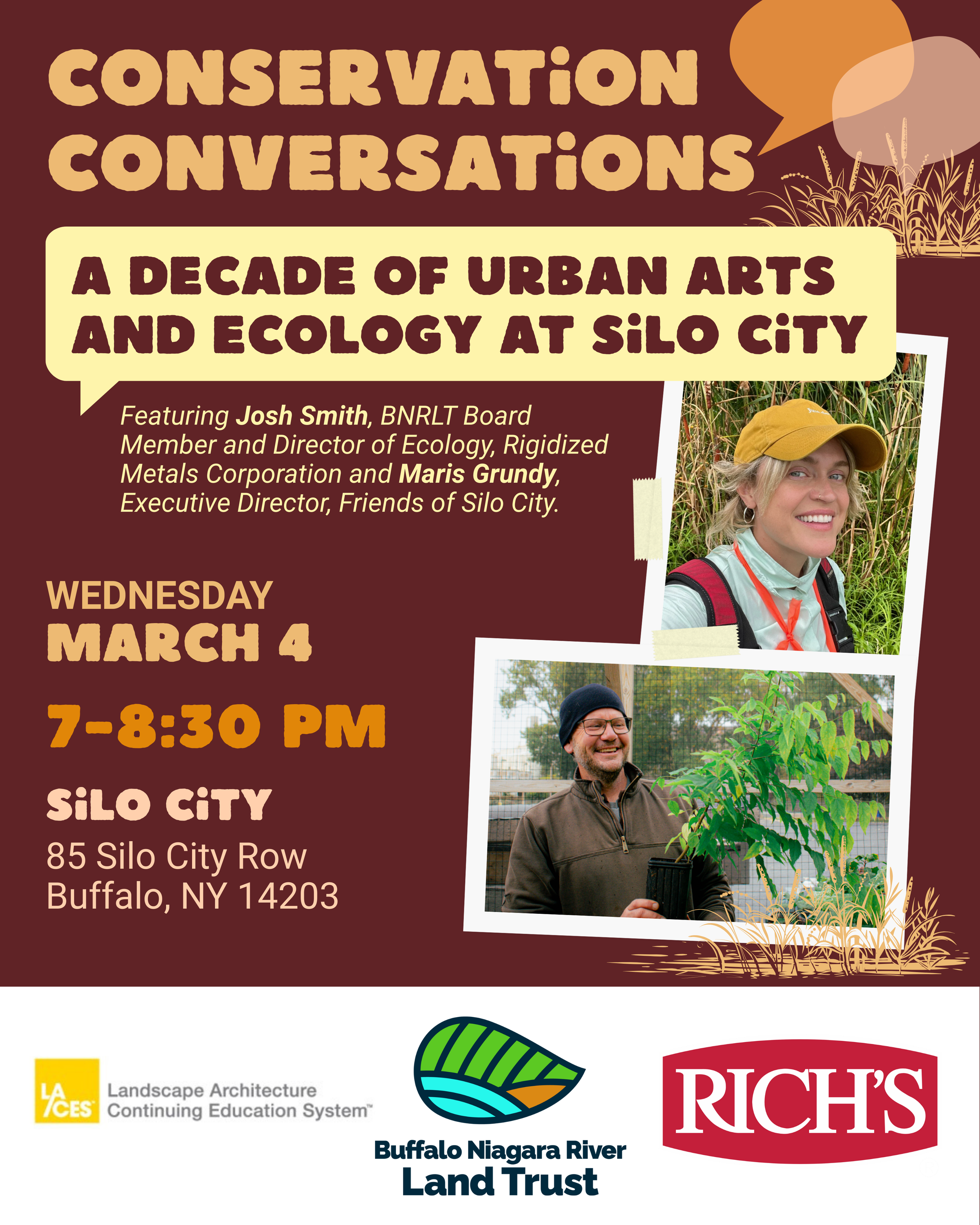
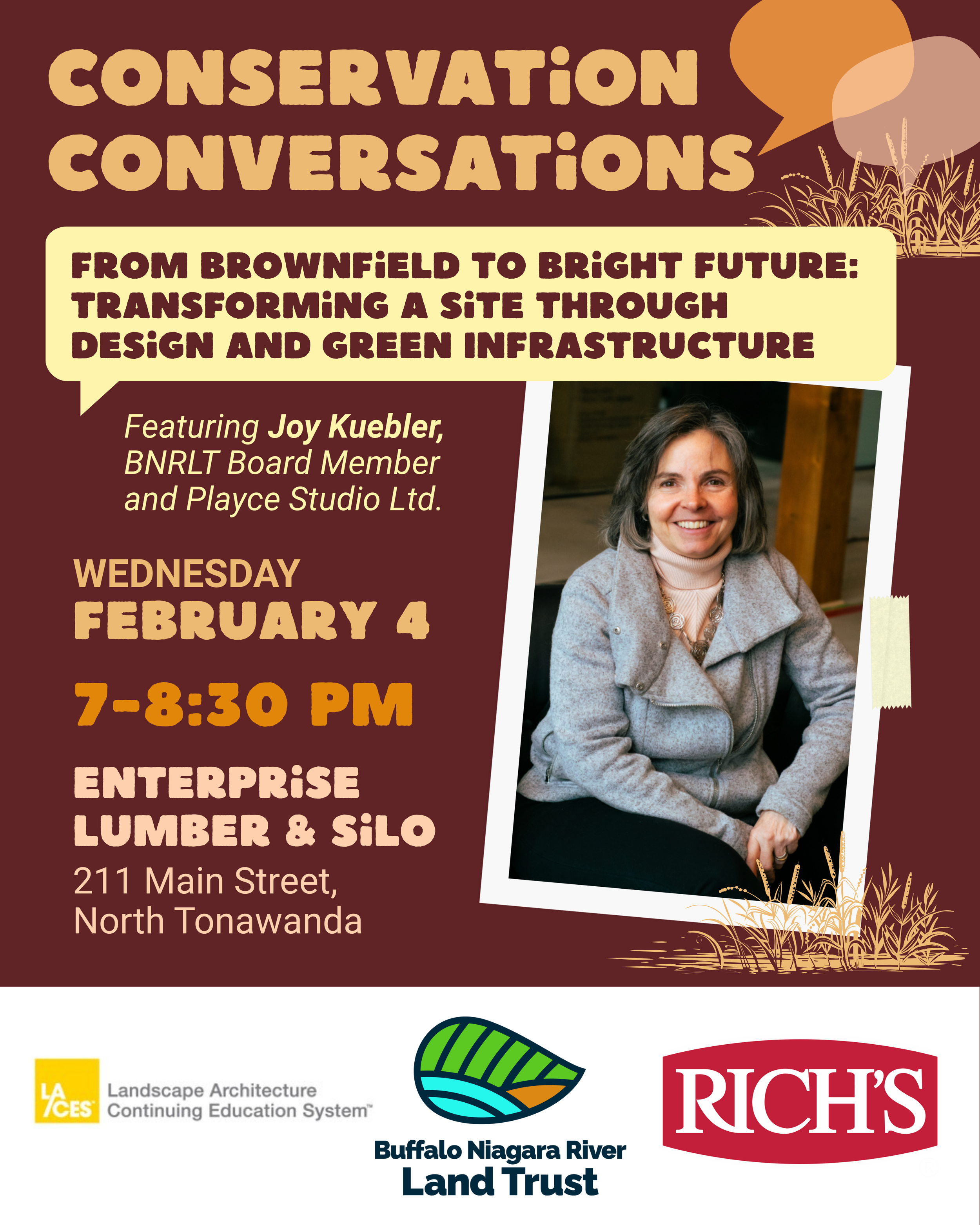
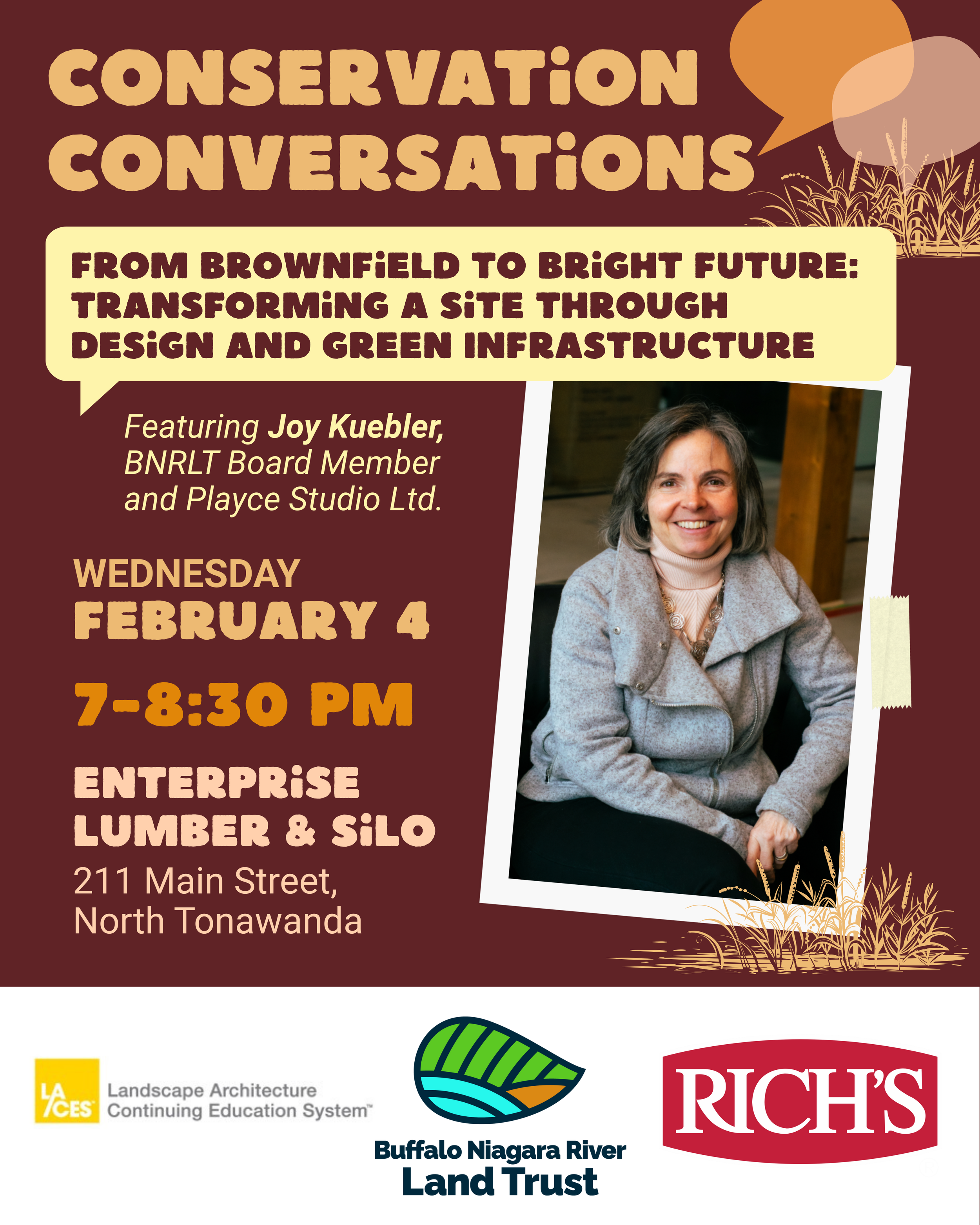
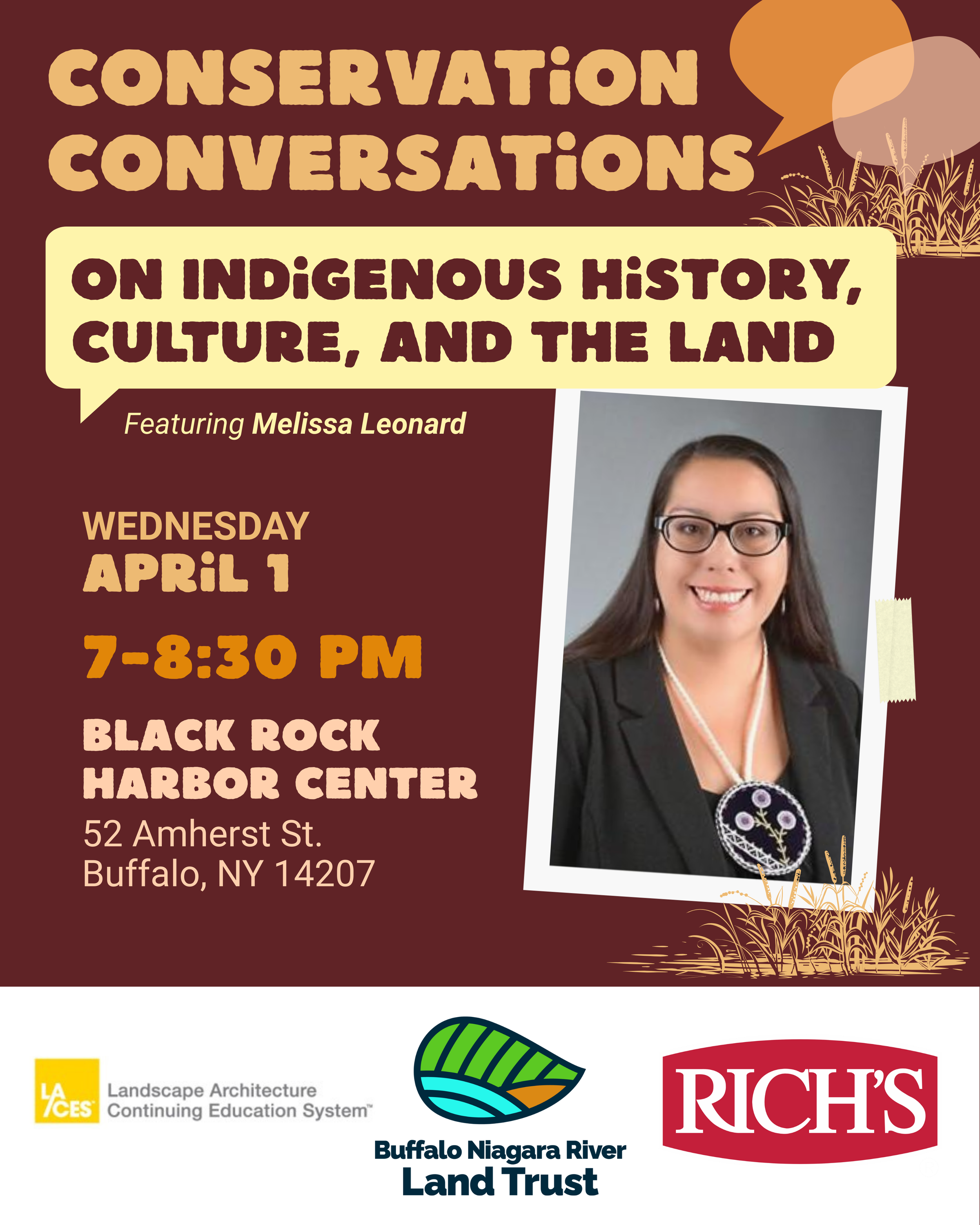
The Buffalo Niagara River Land Trust Speaker Series brings together the community and experts to explore how we can reclaim and restore Western New York’s waterfronts.
Through these conversations, we highlight our mission to clean, protect, and keep these places in trust—ensuring public access, environmental health, and community pride for generations to come.
We’ll ask, What is a brownfield? What is the difference between a Land Bank, a Land Conservancy, and a Land Trust? We will learn about phytoremediation–the use of plants and trees that are especially good for removing contaminants from the soil, groundwater, and sediment–think cattails and cottonwood trees.
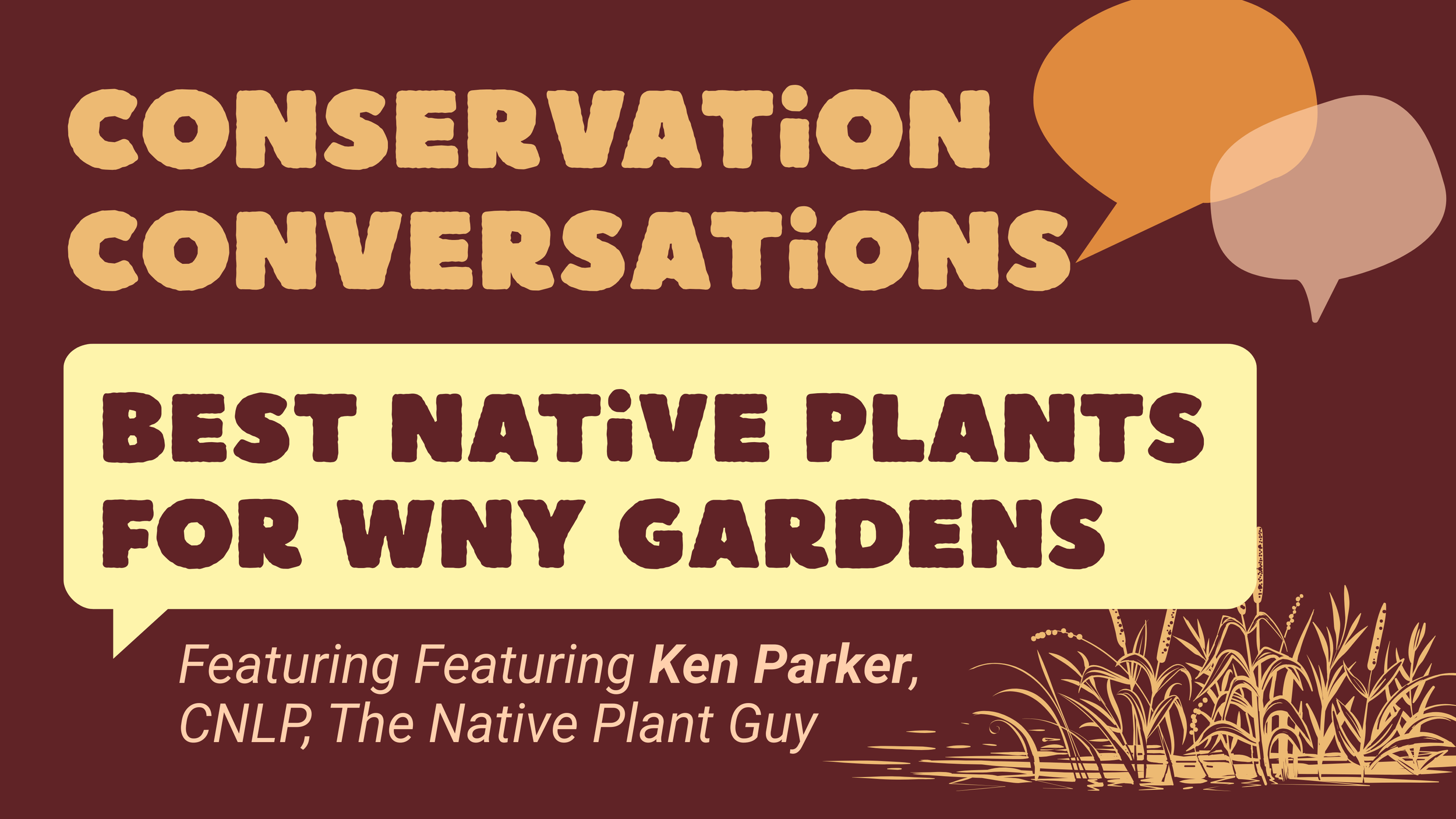
Ken Parker is an Indigenous horticulturist and member of the Seneca Nation of Indians with over thirty years of experience as a professional grower, nurseryman, consultant, and public speaker. He is a lifetime New York State Certified Nursery Landscape Professional (CNLP) and former trainer for the National Green Infrastructure Program. Ken has participated in many conservation and restoration projects. He has been instrumental in cultivating, installing, educating, and advocating for indigenous flora throughout the United States and Canada. Currently, Ken serves as the Native Plant Specialist at Masterson’s Garden Center and holds roles as Membership Chair and board member at Wild Ones WNY.